

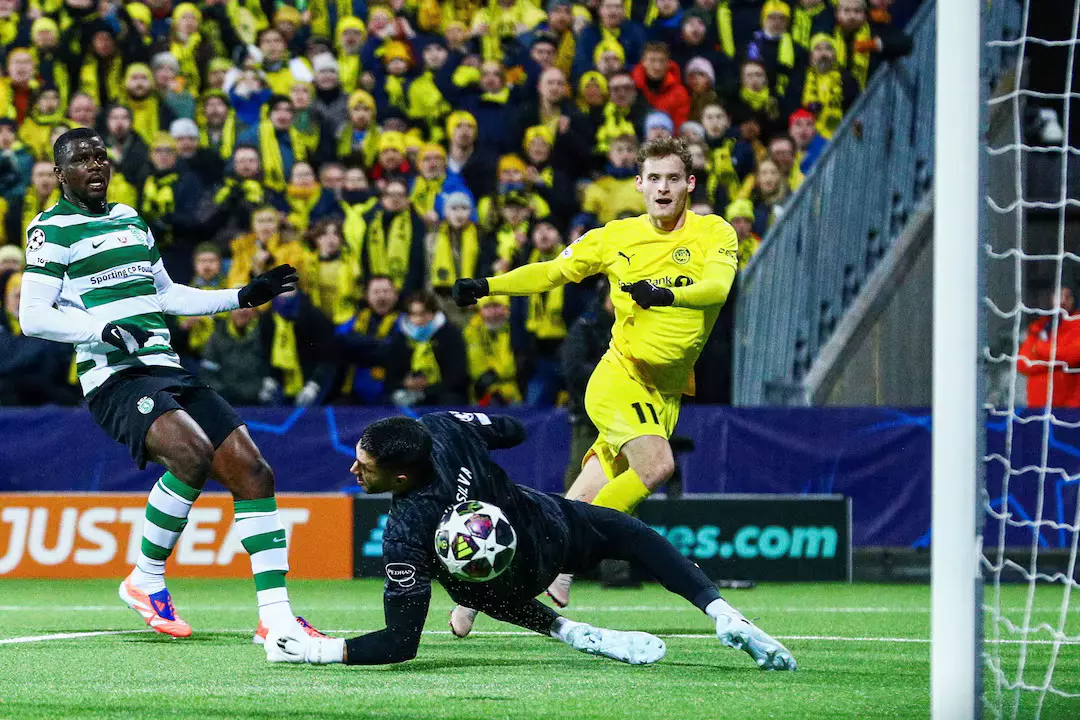
Wednesday night in northern Norway looked like a mismatch on paper. Bodø/Glimt, a club from a fishing town of 54,000 people sitting above the Arctic Circle, hosting Sporting CP in the Champions League, a top-eight seed from Lisbon with a UEFA coefficient ranking of 18.
The result: 3-0. Sondre Brunstad Fet converted a penalty in the 32nd minute, Ole Blomberg added a second just before halftime, and Kasper Houg sealed it in the 71st. The xG was 2.46 to 0.51.
It was not a fluke.
Bodø/Glimt: The Club That Should Not Be Here
Bodø/Glimt entered this round ranked 34th out of 36 clubs by UEFA coefficient. Their league phase record read two wins, three draws and three defeats. By any historical measure of this competition, they were supposed to be gone by February.
Instead, they beat Manchester City 3-1 on their artificial turf pitch in January, then knocked out Inter Milan 5-2 on aggregate in the play-offs, eliminating last season’s runners-up. That made Bodø/Glimt the first Norwegian club to win a knockout tie in Champions League history. People watching the games live, tracking stats or following odds on Linebet APK and similar platforms had to double-check the scorelines multiple times.
None of the three goalscorers against Sporting has been called up by their national team. Fet is 29 and has never played for Norway. Blomberg is 25 and equally uncapped. Houg, also 25, has no Denmark appearances. Their top performer in the competition is Jens Petter Hauge, a former AC Milan loanee who joined the Bodø academy at age 13.
What gives a side like this the platform to go this far? The answer is the new format.
What the Champions League’s New Format Actually Changed
UEFA replaced the old group stage with a single 36-team league table. Every club plays eight matches against eight different opponents. The top eight advance directly to the round of 16. Teams ranked 9th through 24th enter a two-legged knockout play-off. The bottom 12 are out.
Here is what the new structure gives smaller clubs that the old one never could:
- Eight matches instead of six, more runway to build points before the table settles
- A wider variety of opponents, reducing the impact of one bad early draw
- A play-off round as a genuine second chance, not a drop to a lesser competition
- Current form weighted more heavily than historical reputation
Bodø/Glimt drew with Tottenham at home and Dortmund away in the league phase. In the old format, those results across six games might not have been enough to progress. Across eight, the points accumulated and the picture changed.
The Run That Explains Everything
Since January 2026, Bodø/Glimt have won five Champions League matches in a row. All of this happened during Norway’s domestic off-season, before their Eliteserien season even started.
Their path from the league phase onwards:
- Matchday 7: Beat Manchester City 3-1 at Aspmyra Stadium
- Matchday 8: Beat Atletico Madrid 2-1 away
- Play-off first leg: Beat Inter Milan 3-1 at home
- Play-off second leg: Won 2-1 at San Siro to seal a 5-2 aggregate win
- Round of 16 first leg: Beat Sporting CP 3-0 at home
Sporting became the third major club this season to travel to northern Norway and leave beaten. City and Inter both lost 3-1 on the same artificial pitch before them.
The club’s mental coach is an active military pilot named Bjorn Mannswerk. After six matches without a win in the league phase, the staff made a deliberate decision to release pressure and stop thinking about qualification altogether. Five straight wins followed.
YOU MAY ALSO LIKE: Reece James Hamstring Injury Worsens Chelsea’s Defensive Woes and Threatens 2026 World Cup Hopes

Why This Is Different From Past Underdog Runs
Every Champions League era has had its surprise. APOEL Nicosia from Cyprus reached the quarter-finals in 2012. Isolated results from smaller clubs have always occasionally appeared. But those were single moments in a format where finishing third earned a Europa League spot and the story quietly ended.
The new format rewards something the old one structurally could not: a slow start followed by a strong finish. It asks a different question of clubs. Not “can you go unbeaten in a six-game group?” but “can you accumulate enough quality across eight matches to stay relevant?”
For a club from a city smaller than the capacity of most rival stadiums, that second question is much more answerable. Bodø/Glimt did not win a single game in their opening six matches but their performances consistently suggested they belonged at this level.
That sentence could not have existed in the old format. Six games with no wins meant elimination. Full stop.
65% of the prize pool now distributes based on actual results rather than historical coefficient. The base participation fee is 18.62 million euros per club. That financial structure supports the sporting one: if you perform, you get paid for it, regardless of your history.
What the Quarter-Finals Would Mean
The winner of this tie faces either Arsenal or Bayer Leverkusen in the quarter-finals. Arsenal finished the league phase with eight wins from eight, conceding four goals across all eight matches. Leverkusen held them to a 1-1 draw in the first leg on March 11.
A Bodø/Glimt quarter-final would be the deepest run by a Norwegian club since Rosenborg reached the last eight in 1996/97. It would also be the most dramatic single-season progression the new format has produced so far.
The return leg is in Lisbon on March 17. Sporting have the crowd, the history and a UEFA ranking 16 places higher. Bodø/Glimt have a three-goal lead and five consecutive wins in a competition they were never supposed to still be playing in.
That specific tension is exactly what the redesigned Champions League was built to create.