
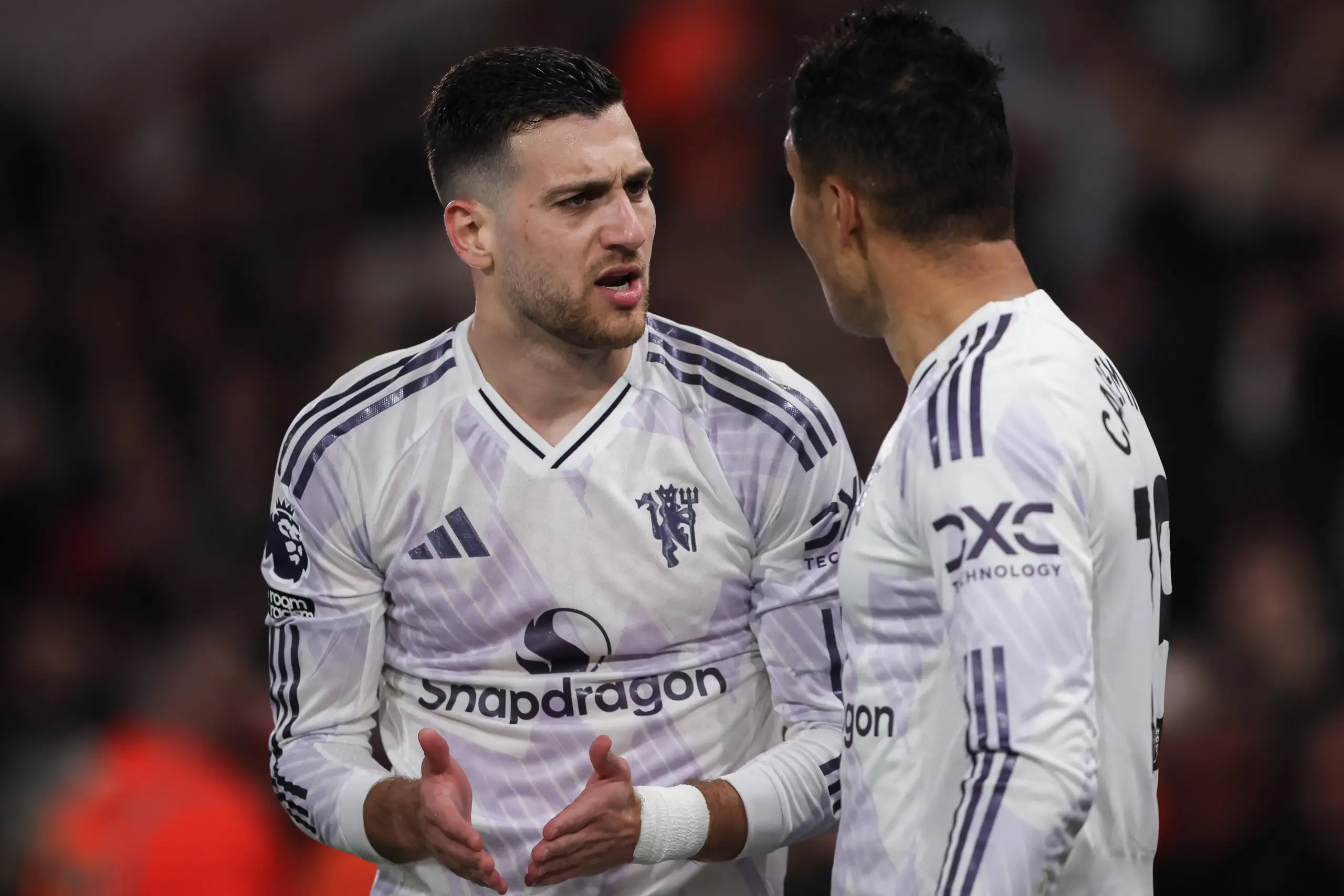
Manchester United’s lack of control remains evident across the full course of a match.
Even in performances that appear composed, the underlying rhythm often slips away from them, turning structured phases into fragmented contests shaped by transitions, rushed decisions and moments of individual quality.
Signs of progress are evident.
The team looks more compact than it did in previous seasons, distances between units are shorter, and defensive organisation appears more deliberate.
Yet those improvements have not translated into sustained authority over matches. A sustained sense of control still feels just out of reach.
That relative stability has underpinned a strong run of results, but it has not yet translated into consistent authority over matches.
Why Manchester United’s Lack Of Control Persists
Manchester United’s lack of control is not due to the absence of structure, but rather its limitations in having a recognisable structure because structure alone rarely translates into dominance.
Organisation provides stability, but control demands something more nuanced: the ability to dictate tempo, manage risk and impose a rhythm that others must follow.
United’s games still drift in key phases. Periods of calm possession are interrupted by hurried forward play, while phases of pressure dissolve into open exchanges. The team can settle into games, but rarely sustain that feeling of command.
At the elite level, control is defined by continuity. It is the capacity to link phases together – to move from build-up to progression to sustained pressure without losing composure. United’s difficulty lies precisely in that transition between phases.
Control vs Organisation: A Subtle But Crucial Distinction
It is tempting to equate improved organisation with control. United have, to an extent, become more disciplined. Their shape without the ball is clearer, and the more chaotic phases that once defined their performances have been reduced.
However, organisation is reactive by nature.
It allows a team to respond effectively, to remain in games, and to avoid being overwhelmed.
Control, by contrast, is proactive.
It involves:
• managing tempo rather than reacting to it
• sustaining possession with purpose
• applying pressure without losing structure
United often achieve the first without fully translating it into the second. They can stabilise matches, but they do not consistently dictate them.
Why Manchester United’s Lack Of Control Is Most Evident In Midfield
Manchester United’s lack of control is most evident in midfield, where matches are shaped and tempo is defined.
While the unit has shown greater discipline and positional awareness, it still lacks the authority required to manage games over extended periods.
Build-up often feels uneven. At times, progression is too cautious, slowing the rhythm unnecessarily.
At other times, passes become too direct, bypassing the possibility of sustained possession over time. This inconsistency prevents United from settling into a controlled tempo.
The result is a recurring pattern:
• possession without penetration
• progression that lacks consolidation
• attacks without sustained territorial pressure
Midfield, rather than acting as the centre of control, becomes a transitional space – a conduit rather than a platform for control.
YOU MAY ALSO LIKE: Kobbie Mainoo’s New Contract: How Manchester United Nearly Made A Costly Mistake With Their Golden Boy
Manchester United’s Lack Of Control: Moments Over Mastery
Despite these limitations, United remain capable of decisive contributions in key moments.
Individual quality continues to shape outcomes, particularly in advanced areas where creativity and improvisation can compensate for structural shortcomings.
Goals often arise from transitions, rapid combinations, or isolated flashes of brilliance. Such instances can give the impression of control, particularly when results are favourable.
Yet reliance on isolated actions introduces volatility. Teams that compete at the highest level tend to minimise randomness rather than depend on it. They establish conditions that shape outcomes through sustained patterns, rather than isolated events.
United, by contrast, often operates within a degree of uncertainty. Games open up not by design, but because authority has not been firmly established.
Manchester United’s Lack Of Control: A Good Run Of Form Highlights Weaknesses
Manchester United’s lack of control remains a defining issue, and that single issue connects many of the team’s broader inconsistencies.
It explains why:
• performances fluctuate within the same match
• periods of dominance rarely translate into sustained pressure
• leads can feel less secure than they should
• results sometimes mask underlying instability
Without control, structure becomes fragile. Without sustained rhythm, even well-organised teams can appear unpredictable.
Manchester United’s Lack Of Control: A Defining Factor In The Red Devils’ Progression
There is clear progress in United’s development. The team is more organised, more compact and less prone to the kind of disorder that once defined its performances.
However, control is a higher threshold – and a more demanding one.
It is not enough to reduce chaos; elite teams replace it with authority. United have moved beyond the most erratic aspects of their recent past, yet they have yet to translate that progress into a stronger grip on matches on their own terms.
Until that shift occurs, improvement will remain partial – visible in brief spells, but not yet sustained across the full arc of a game.
Main Photo
Credit: IMAGO / Action Plus
Recording Date: 20.03.2026