
Hugo Ekitike’s injury has been confirmed as an Achilles tendon rupture, one of the most severe injuries a footballer can suffer.
Often described as a potential “career-ending” setback, the injury will rule the 23-year-old French international out of action for an extended period, with an estimated recovery timeline of eight to nine months.
The devastating nature of an Achilles tendon rupture means Ekitike is now set to miss the 2026 World Cup, dealing a huge blow to both his personal and national team’s ambitions.
The injury occurred during Liverpool’s 2-0 loss to Paris Saint-Germain in the quarter-finals of the UEFA Champions League, with confirmation arriving on Wednesday following detailed medical scans.
Ekitike, who had been one of Liverpool’s standout performers this season since his move from German club Eintracht Frankfurt, registered an impressive 15 goal contributions in 28 Premier League appearances.
His absence now leaves a noticeable gap, both in Liverpool’s attack and in the trajectory of a player whose season had been building real momentum.
The Science Behind Hugo Ekitike’s Injury: How An Achilles Tear Impacts Elite Footballers
The Achilles tendon is the thickest and strongest tendon in the human body, acting as the primary bridge between the powerful calf muscles and the foot.
For a footballer, it functions as a high-performance “biological spring” that is essential for almost every movement on the pitch, from sprinting and jumping to shooting.
It is responsible for 90% of the calf’s power. For a striker like Ekitike, this is the engine for the “first-step” acceleration used to beat defenders.
The Achilles tendon aids explosive acceleration of players, transmitting force from the calf muscles to the heel bone to propel the player forward. In sprinting, it can contribute upwards of 75% of the total positive power.
During high-speed sprinting, the tendon must withstand forces up to 12 times a player’s body weight and sudden changes of direction — such as lunging into a tackle — the Achilles tendon plays a crucial role in controlling eccentric forces. It allows the athlete to decelerate and pivot efficiently, reducing the strain placed on the knees and hips.
For goalkeeping saves, it absorbs energy during the downward phase of a jump and releases it during takeoff to maximise height. This shows just how vital the Achilles tendon is to a footballer’s overall performance and physical stability.
According to ESPN’s French journalist Julien Laurens — who cited sources close to the player — the severity of the moment was unmistakable: “He heard his Achilles pop before collapsing on the floor in pain.”
That “pop” strongly suggests a potential Grade 3 Achilles tendon rupture — the most severe form of the injury.
It’s the same type suffered by his French teammate Presnel Kimpembe, who required surgery to repair the torn tendon and was sidelined for over 600 days, spending well beyond a year out of action.
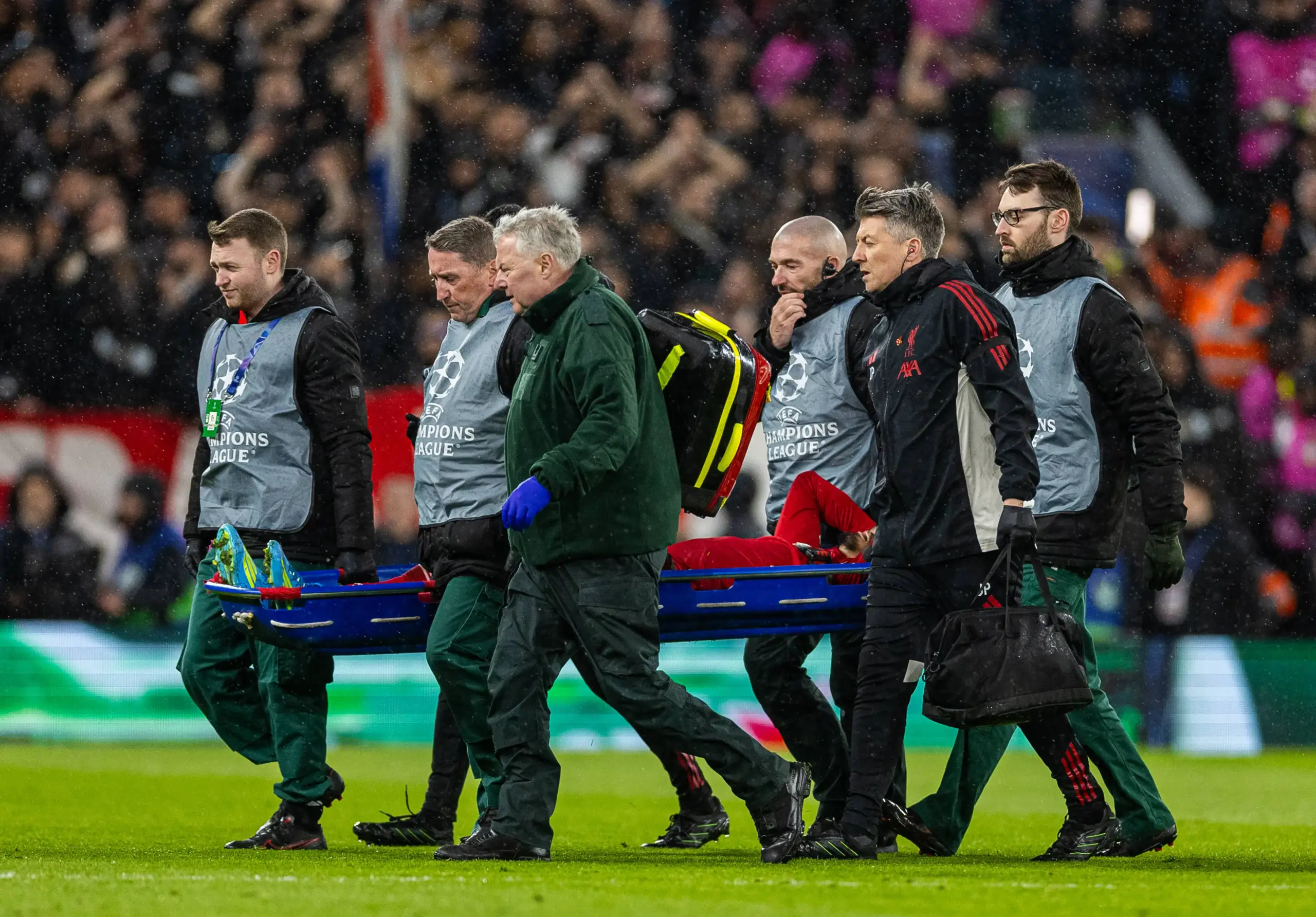
Ekitike was subsequently stretchered off the pitch in visible distress, leaving Anfield in tears — a scene that underscored the devastating nature of the injury.
YOU MAY ALSO LIKE: PSG’s Knockout Stage Dominance: Why Liverpool vs Paris Saint-Germain Proved Their Strong Evolution After The League Phase
Hugo Ekitike’s Injury: A Crushing Blow To His Season And 2026 World Cup Dream
Like many players before him, Hugo Ekitike’s injury has abruptly brought his season to an end, ruling him out of all competitions for close to a year.
For the 23-year-old, the timing could not be worse — it also means the heartbreaking loss of his 2026 World Cup dream, a reality already confirmed by France head coach Didier Deschamps.
Although basic recovery can take around six months, the demands of elite-level football extend that period significantly. In most cases, players require between nine and 12 months to fully recover, ensuring the tendon is strong enough to withstand the intense physical strain of top-flight football.
Before Hugo Ekitike’s injury, the French forward had emerged as Liverpool’s primary attacking threat, especially during Mohamed Salah’s dip in form and Alexander Isak’s absence through injury.
His influence in the final third played a key role in Liverpool’s push for a top-five finish, as they battle to secure qualification for next season’s Champions League.
Achilles Tendon Rupture: Can Hugo Ekitike Return To His Best Form After The Injury?
Yes, Ekitike can return to his best form after recovering from the Achilles tendon injury, but statistically, it won’t be immediately, as data suggests it will likely be a multi-season journey rather than a swift comeback.
Despite improvements in modern science, the injury remains one of the most challenging for explosive athletes.
Studies indicate that between 78% to 82% of professional footballers successfully return to action after an Achilles tendon rupture.
However, even after the typical nine-month recovery period, performance metrics — such as goals, assists, and minutes played — often remain noticeably below pre-injury levels for the first 12 to 16 months.
Ekitike does have a significant advantage in his favour: his age.
At 23, he is younger than the average player who suffers this type of injury, which is usually between 27 and 29 years old.
Younger athletes tend to respond better to rehabilitation, increasing the likelihood of regaining their pace and explosiveness.
A key factor in his recovery will be surgical precision, particularly in restoring the tendon’s original length.
Even a slight elongation during repair can permanently reduce the striker’s “push-off” power — a critical component of acceleration and sharp movement in attack.
Main Photo
Credit: IMAGO /Propaganda Photo
Recording Date: 14.04.2026