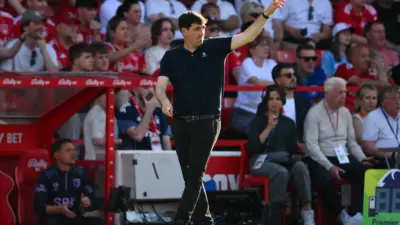


After close to four months in charge, Liam Rosenior’s sacking was confirmed on Wednesday, April 21 – news that was welcomed by a large section of the Chelsea fanbase, many of whom had been calling for his dismissal after enduring a run of poor results in his final months in charge.
Chelsea’s final four Premier League fixtures, along with their FA Cup semi-final clash against Leeds United, will now be overseen by interim manager Calum McFarlane, who has been placed in charge until the end of the season.
The decision to end Rosenior’s contract followed a crushing 3-0 defeat to Brighton – a match in which the Blues failed to register a single shot on target across 90 minutes – and ultimately proved to be the final straw.
Despite the former Strasbourg coach’s repeated claims of having the full backing of the Chelsea board, Liam Rosenior’s sack was ultimately sanctioned as the club’s hierarchy lost patience with the team’s alarming decline in form, lack of attacking identity, and growing pressure surrounding the project.
Chelsea’s Goal Drought and Loss of Form: The Downfall Behind Liam Rosenior’s Sack
To some, Liam Rosenior’s dismissal feels harsh. He was appointed without the benefit of a pre-season or a transfer window to bring in players suited to his system, while injuries to key figures only made matters worse.
Against Brighton, Chelsea were without their entire creative spine, with Cole Palmer, Estêvão, and João Pedro all sidelined.
And the fact that he signed a six-year contract, only to be dismissed 107 days later – making him the shortest-serving permanent manager in the club’s history – raises serious questions about the club’s long-term planning and patience.
Still, football remains a results-driven business, and a failure to deliver ultimately cost him his job.
Under Rosenior, Chelsea’s goal drought hit a new low, plunging the club deeper into what now feels like a full-blown crisis. The Blues have gone five consecutive games without finding the back of the net – their longest such run since 1912.
It’s been 490 minutes, dating back to early March, since the club last scored a goal – a staggering statistic that underlines just how far performances have slipped.
Off the pitch, it’s not any better. The club recorded what is now their worst-ever return on investment, announcing a staggering £262.4 million pre-tax loss for the 2024/25 season – the largest in English football history.
Financial concerns have only deepened, with UEFA handing Chelsea an initial €31 million fine for breaching sustainability regulations, alongside the threat of further penalties rising to €60 million if targets are not met.
The unrest has spilled beyond Stamford Bridge. Protests have erupted in London, with Chelsea’s French sister club Strasbourg joining in solidarity, unveiling a “BluecoOut” banner to voice growing frustration with the ownership.
That frustration has now taken a more formal tone. The Chelsea Supporters’ Trust issued an open letter to the board, criticising what they describe as a complete lack of clarity, direction, and accountability from the club’s leadership.
All of it paints a bleak picture – one where Chelsea’s goal drought is no longer just a problem on the pitch, but a symbol of a club spiralling on every front.
Why Chelsea’s Goal Drought Could Cost Them a Crucial Champions League Spot
Mathematically, it is still possible for Chelsea to qualify for the Champions League, but realistically, the outlook is bleak – and Chelsea’s goal drought plays a part in it.
The Blues have struggled for consistency on both ends of the pitch. Since Liam Rosenior took charge, Chelsea have managed to keep a clean sheet in just one league game – a 2-0 win against Brentford – exposing a defensive fragility that continues to undermine any hopes of a late push up the table.
If these issues remain unresolved, a top-four finish feels increasingly out of reach – with even a bottom-half finish becoming a genuine concern.
But it’s not just the defence. Chelsea’s goal drought has compounded the problem. The failure of the attackers to create and convert chances has stripped the team of any attacking edge at a crucial stage of the season.
The Blues’ forward line looks nothing like the unit that lifted the Club World Cup just months ago. Instead, it feels as though every attacking player has lost form at the same time – a collapse that has directly fueled Chelsea’s lack of goals.
Cole Palmer, once Mr reliable and the team’s standout performer, is now enduring an eight-game goalless run, a stark contrast to his earlier influence.
Pedro Neto has also seen a sharp dip in output, with his recent performances lacking quality – the Portuguese now finds it hard to beat his man in a 1v1, his crosses have been ineffective, his shooting unreliable, and his game increasingly dependent on raw pace rather than end product.
A similar pattern can be seen with Alejandro Garnacho, whose struggles have drawn heavy criticism from supporters. His display against his former club, Manchester United, in the 1-0 defeat, along with an underwhelming cameo against Brighton, has only intensified calls for the club to consider moving him on at the end of the season.
In midfield, Enzo Fernández – a dangerous “box-crasher” and a consistent goal threat under Enzo Maresca – appears to have lost that attacking edge, no longer making the decisive runs or contributions in the final third.
Further forward, João Pedro has struggled with inconsistency, drifting in and out of games without making a sustained impact. Meanwhile, Estêvão, who has shown glimpses of being a potential difference-maker, suffered another setback after going down with a recurring hamstring injury against Manchester United.
Altogether, it’s a forward line short on confidence, cohesion, and cutting edge – and until that changes, Chelsea’s goal drought looks set to continue.
From Promise to Collapse: How Chelsea’s Season Unravelled Under Liam Rosenior
The Englishman’s tenure at Stamford Bridge began brightly, with seven wins from his first ten games in all competitions. But since Chelsea’s exit in the Champions League round of 16, things have gone from bad to worse.
April, in particular, has been a complete collapse, with the Blues suffering three consecutive defeats to Manchester City, Manchester United, and now Brighton.
Under the former Strasbourg coach, Chelsea have won just one of their last eight matches – a run that looks even worse when you remove the outlier 7-0 victory over League One’s Port Vale.
These numbers paint a worrying picture: a side that cannot defend reliably, cannot score consistently, and is rapidly running out of games to fix either issue. Unless there is a dramatic turnaround, Chelsea’s goal drought may ultimately define their season – and cost them a place in next year’s Champions League.
YOU MAY ALSO LIKE: Chelsea Manager Search: Who Could Replace Liam Rosenior at Chelsea?

Chelsea vs Leeds: Calum McFarlane Set to Take Charge of the Blues’ FA Cup Semi-Final
Chelsea’s next fixture is the FA Cup semi-final against Leeds United, with Calum McFarlane – now in his second spell as Blues head coach – tasked with steadying the ship and finding a way to end the season on a positive note.
Leeds United arrive in strong form and will pose a genuine threat to the Blues. Both sides have already met in the Premier League twice this season, with Leeds taking four points from a possible six.
The Whites have lost just twice in their last 12 games – narrow 1-0 defeats against Manchester City and Sunderland – and head into the Chelsea clash full of confidence after beating Manchester United at Old Trafford.
Meanwhile, a victory for Chelsea would go some way in easing the mounting pressure around the club, as the hierarchy prepares to make yet another managerial decision – their fifth appointment in just four years since the takeover.
As things stand, he is visibly feeling the strain of managing a club of Chelsea’s size in such turbulent circumstances, with expectations remaining as high as ever despite the ongoing struggles.
Main Photo
Credit: IMAGO /Action Plus
Recording Date: 21.03.2026