

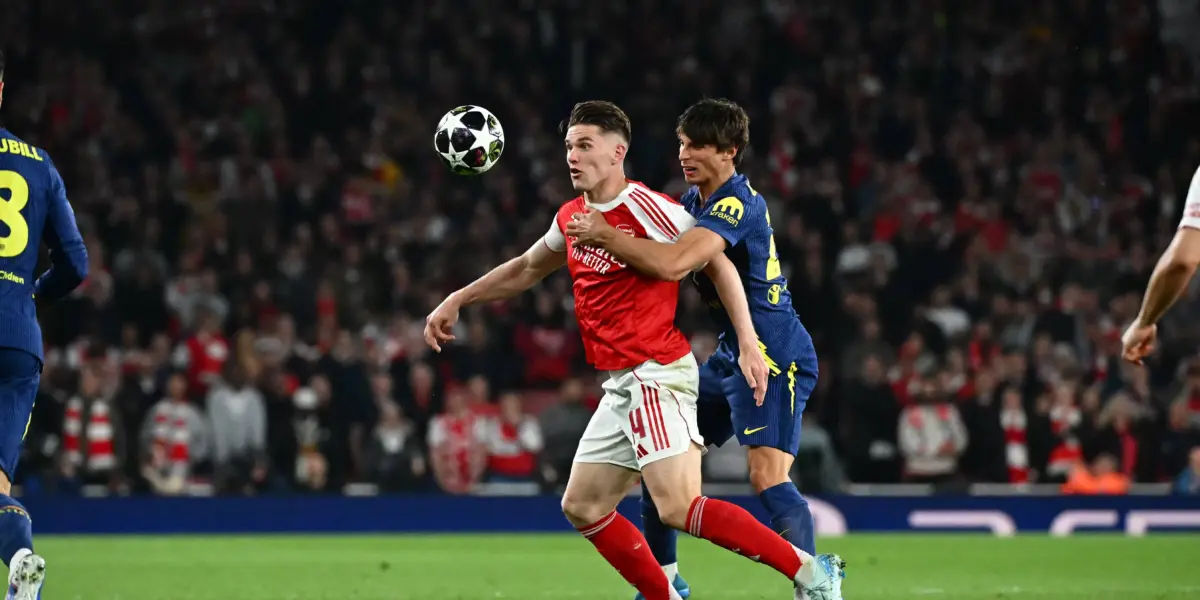
It was a proud moment for the Gunners supporters as the final whistle blew, confirming Arsenal’s UEFA Champions League Final qualification after a hard-fought 1-0 victory in the second leg of their semi-final encounter with Atletico Madrid at the Emirates Stadium — the Gunners’ first UCL Final since 2006.
Diego Simeone’s men, who made things difficult for the Gunners across both legs, still had spells where they looked capable of drawing level. Yet, each time they attacked, the composure of the Arsenal backline repelled every threat, with David Raya rarely tested in goal.
Gabriel Magalhães, who was at the centre of their defensive masterclass, once again showed why Arsenal boast the best defence across Europe’s top five leagues this season, producing crucial interventions at decisive moments to preserve their slim advantage.
Arsenal’s victory against Atletico was a collective effort, but the game was also influenced by moments of individual brilliance that tilted the balance when it mattered most.
At this crucial stage of the competition, qualification is often decided by fine margins and moments of brilliance from individual players, and against Atleti, Viktor Gyokeres was the man who troubled the Spanish side the most.
Arsenal’s UEFA Champions League Final Qualification: From Coventry To The Champions League Final
The career of the Swedish international is an inspirational story, as he has shown that persistence and development can reshape a player’s trajectory.
From his early days at Coventry City to becoming a decisive force in Europe’s biggest competition, Gyokeres’ rise has been anything but conventional.
Despite his profound record at Sporting Lisbon in Portugal, there were still doubts about whether he could replicate that form in the Premier League and on the Champions League stage.
However, Gyokeres’ performance against Atlético Madrid in the semi-final has proved many of his doubters wrong, as he delivered a display defined by physical dominance, intelligent movement, and constant threat in advanced areas.
The Arsenal striker’s effect in the UCL semi-final was the driving force that saw the Gunners keep possession high up the pitch and kill the momentum that Atlético Madrid were trying to build.
Nicknamed “the Bully” by his Arsenal teammates, he really did torment the Spanish side’s backline. He didn’t just keep the defenders busy — he unsettled them, forced errors, and created space that allowed Arsenal to control key moments of the tie.
In a semi-final where margins were razor-thin, his presence became a decisive factor in Arsenal’s first UCL final since 2006, marking a defining night in both his career and the club’s European journey.
YOU MAY ALSO LIKE: David Raya Golden Glove: What Has Driven His Three-Peat Success?
Arsenal’s UEFA Champions League Final Qualification: Gyokeres’ Performance Shows Why He’s Arsenal’s Missing Piece Under Arteta
Mikel Arteta has spent seven years shaping this Arsenal side, working with strikers of varying profiles — Alexandre Lacazette, Pierre-Emerick Aubameyang, Eddie Nketiah, and Gabriel Jesus — with each offering distinct qualities.
Yet none have quite mirrored the profile of Gyokeres, who represents something entirely different within Arteta’s attacking framework. With the Swede, there is a growing sense that the manager has finally found the missing piece to his tactical puzzle.
Those previous forwards brought pace, finesse, and technical sharpness. Gyokeres, however, introduces a more imposing dimension — raw power and relentless physicality. He operates as a central magnet, pinning elite centre-backs, forcing them into constant engagement, and disrupting defensive structures.
That presence alone creates space in wider areas, naturally easing the pressure on players like Bukayo Saka — whose goal was enough to lift Arsenal into the Final.
Gyokeres’ performance deserved a goal to add to the 21 he already has in all competitions, but his influence extended far beyond goalscoring.
His ability to sustain attacking phases and convert chances efficiently has added a clinical edge to Arsenal’s play — one that is quietly strengthening their push for a potential double.
Gyokeres’ Performance Key To Arsenal’s UEFA Champions League Final Qualification And Historic Ambitions
With 14 goals in the Premier League and five in the Champions League, his goals are driving Mikel Arteta’s side toward a potential historic double. It is the Swede’s all-round play that truly elevates Arsenal’s attack.
His ability to hit a top speed of 34.07 km/h makes him a constant threat in transition, while his average of 8.64 kilometres per match underlines his work rate as a modern, hard-pressing striker perfectly suited to Arteta’s system.
If that level of Gyokeres performance against Atlético Madrid can be sustained in Arsenal’s remaining fixtures — especially in the Champions League final in Budapest — then the Gunners will have every reason to believe they can achieve their ambitions this season.
Main Photo
Credit: IMAGO /PRESSE SPORTS
Recording Date: 05.05.2026