
VAR controversies have become one of the biggest talking points in modern football, with almost every matchday producing a moment that sparks outrage among fans, players, managers, and pundits alike.
Whether it is a penalty appeal waved away, a yellow card many believe deserved a straight red, or the lengthy delays caused by VAR reviews, referees in the Premier League now operate under an intense level of scrutiny far greater than anything seen in previous eras.
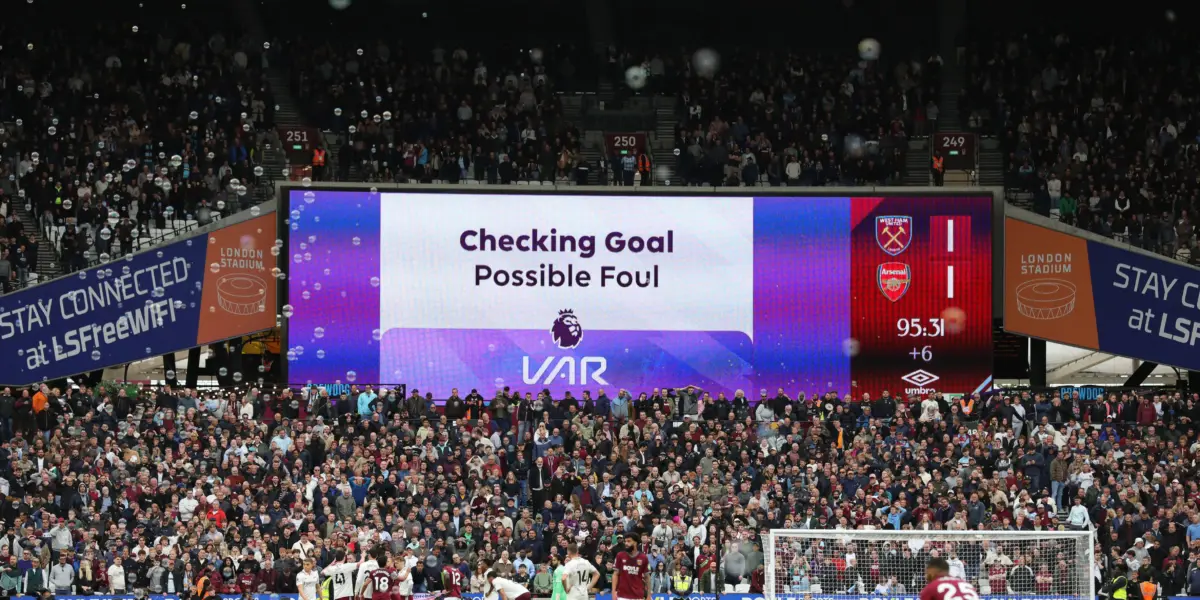
After the latest refereeing controversy in the West Ham vs Arsenal clash – a game with huge implications for both the Premier League title race and relegation battle – it was difficult not to sympathise with matchday referee Chris Kavanagh, as almost any decision he made, whether correct or not, was always going to attract heavy criticism from one side or the other.
In another sense, one could also understand the frustration from supporters, as the inconsistencies in refereeing decisions throughout the season have made it increasingly difficult for fans, players, and managers alike to fully trust the judgment of officials.
West Ham’s disallowed goal against Arsenal, after a ruling from Kavanagh, has become the centre of widespread debate, as social media became flooded with videos and images of similar incidents from earlier in the season that were allowed to stand.
The wave of comparisons has once again cast Premier League refereeing in a negative light, reigniting concerns over officiating decisions.
VAR Controversies: How Referees Came Under More Pressure Than Ever
Before the introduction of VAR, refereeing decisions – right or wrong – were final, and their consequences became part of the game’s natural chaos.
While its arrival was expected to reduce human error and improve fairness, it has instead introduced a new layer of expectation: that every single decision must be corrected with near-perfect accuracy.
And when a decision does not go in favour of a particular club, its fanbase often directs their anger entirely at the officials, turning what should be a moment of sporting debate into a wave of online backlash.
Referees now face the added tension of being publicly scrutinised and, at times, visibly corrected on stadium screens in front of thousands of fans when they get a call wrong during live play.
Anytime a Referee gets called to the monitor, it could feel like a moment of intense judgement rather than assistance, as every angle is dissected, replayed, and debated in real time across social media.
A case that often comes to mind is Mike Dean’s spell as VAR during a 2022 Premier League match between Chelsea and Tottenham Hotspur, where a significant on-field error by referee Anthony Taylor was left uncorrected.
Dean later admitted that, as Taylor’s “mate,” he was reluctant to intervene by recommending an on-field review, saying he did not want to further “humiliate” a colleague in an already intense and high-pressure situation.
That decision quickly became a point of debate, as many felt it contributed to a significant refereeing controversy that directly influenced the outcome of the match.
Tottenham Hotspur, who were widely considered fortunate not to be reduced to ten men, went on to score a late equaliser against Chelsea, earning a crucial point that had a notable impact on the Premier League table.
The incident triggered widespread criticism, with accusations of inconsistency and bias intensifying discussions around VAR in football.
Digital Abuse and Its Mental Health Toll
A year after the incident, Mike Dean admitted he had grown to “dread” his role as a VAR official due to the immense pressure of making high-stakes calls in real time, eventually stepping away from refereeing altogether – showing just how mentally demanding officiating has become in modern football.
In earlier times, criticism and verbal abuse would typically end when the final whistle was blown, but now, particularly within the Premier League, it often continues for days or even weeks after a match.
In some cases, it escalates further, with officials and their families becoming targets of online threats and personal abuse.
Recent studies and reports have highlighted the scale of the issue, with over 30,000 abusive posts directed at players and match officials in a single year, and as many as 93% of referees reportedly experiencing some form of verbal abuse.
This growing culture of toxicity in modern football has not only intensified the psychological pressure on referees but has also contributed to a worrying decline in new officials entering the game, raising concerns about the long-term sustainability of refereeing at all levels.
VAR Controversies: The On-Field Siege
While digital abuse takes place behind screens, match officials also face added pressure on the pitch itself when dealing with players who show heightened aggression and constant attempts to influence decisions.
This burden is not just psychological but also physiological, with referees experiencing stress responses such as increased heart rate and cortisol spikes during intense moments of the game.
When players surround the referee in groups to contest decisions, it can create an overwhelming environment that makes it even harder for the official to stay composed and maintain clarity ahead of the next crucial call.
There have also been several instances where players publicly voiced their frustration after controversial refereeing decisions cost their teams valuable points.
In March, Rodri was reportedly fined by the FA following comments he made after Manchester City’s draw against Tottenham Hotspur, where he questioned the neutrality and integrity of referee Robert Jones after a controversial goal was allowed to stand.
Similarly, after West Ham’s disallowed goal against Arsenal, Tomas Soucek openly criticised the officiating, describing the decision as “bad for football” amid growing frustration surrounding VAR controversies in the Premier League.
Manchester United midfielder Bruno Fernandes – who has emerged as a leading contender for this season’s PFA Player of the Year award – has also been outspoken about the inconsistencies in refereeing decisions this season.
Following Manchester United’s defeat to Leeds United in April, the Portuguese midfielder expressed his dissatisfaction with certain rulings made. He said, “I am not talking about the referee.
“If I talk about the ref, I am going to get in very big trouble because the rules are different for everyone, and they play differently for everyone.
“I prefer not to speak. If I speak, I am in big trouble. In big trouble. And I don’t want to be in big trouble.”
He, alongside many other players over the years, has continued to highlight concerns surrounding the state of refereeing in English football, with increasing calls for better communication, and higher officiating standards in the Premier League.
YOU MAY ALSO LIKE: The Most Defining Moments in Irish Football History
Why Constant Rule Changes Make Refereeing More Difficult
With every new season comes another wave of rule changes, meaning modern referees are no longer just match officials but constant students of an evolving game.
The International Football Association Board regularly adjusts interpretations surrounding handball decisions, VAR protocols, added time, and player conduct, forcing referees to quickly adapt while also trying to unlearn habits built over years of officiating.
A handball incident considered natural in one season may suddenly be judged differently the next, creating moments of hesitation during matches as officials attempt to correctly interpret the latest guidelines in real time.
That split second of uncertainty is often enough for players, managers, and fans to react with frustration, especially in high-pressure Premier League environments where every decision is heavily scrutinised.
Referees are constantly expected to deliver consistency across different matches and competitions, but achieving that becomes increasingly difficult when the rules themselves continue to evolve from season to season.
Main Photo
Credit: IMAGO /PPAUK
Recording Date: 10.05.2026