
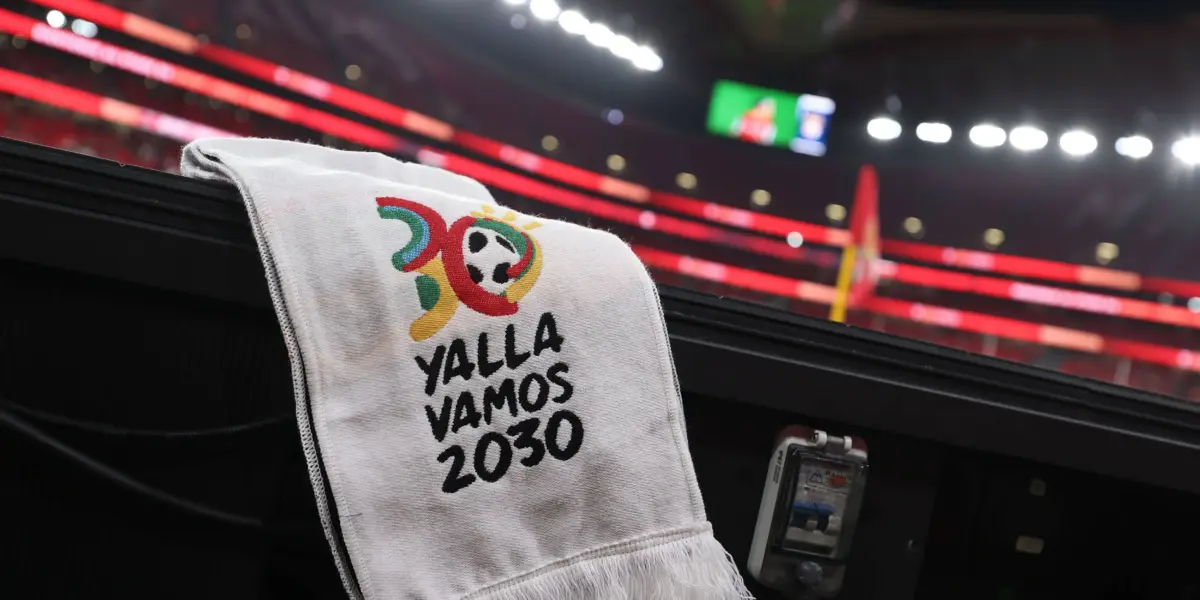
The dust has barely settled on the last FIFA tournament, but attention has already turned to the World Cup 2030, which promises to be one of the most unique editions in football history.
The next World Cup will celebrate the competition’s centenary and will be played across six countries and three continents for the first time.
FIFA has already confirmed the hosts, tournament dates and qualification process, while six nations have booked their places and several others have already seen their hopes of reaching the next World Cup come to an early end.
World Cup 2030 Hosts, Dates and Format Confirmed
The World Cup 2030 will officially get underway on Saturday, June 8, with a special centenary ceremony celebrating 100 years since the first FIFA World Cup was held in Uruguay in 1930.
The ceremony will be followed by the opening matches involving Uruguay, Argentina and Paraguay, the three South American nations selected to host the tournament’s centenary fixtures.
The official opening ceremony for the main tournament will then take place on Thursday, June 13, before the first matches in Morocco, Portugal and Spain are played across June 13 and 14.
Teams drawn in the same groups as Uruguay, Argentina and Paraguay will play their opening fixtures the following weekend, on June 15 and 16, after travelling from South America to the three main host nations.
The next World Cup will conclude with the final on Sunday, July 21.
Like the 2026 edition, the World Cup 2030 is currently expected to feature 48 teams split into 12 groups of four, with the top two teams from each group, along with the eight best third-placed sides, progressing to the round of 32 before the knockout stages continue through to the final.
The unique schedule means the next World Cup will become the first in history to be staged across three continents and six countries, with the opening celebrations taking place in South America before the tournament shifts to Europe and Africa for the remainder of the competition.
Which Teams Have Already Qualified for the World Cup 2030?
Six countries have already secured automatic qualification for the World Cup 2030 because of the tournament’s unique hosting arrangement.
Morocco, Portugal and Spain qualify automatically as the three main hosts, while Argentina, Paraguay and Uruguay have also been awarded places after being selected to stage the opening centenary matches.
That means the next World Cup already has six confirmed participants before the qualification campaign has even begun.
With six places already filled, the remaining 42 spots will be decided through FIFA’s continental qualification tournaments. UEFA, CAF, CONMEBOL, AFC, CONCACAF and OFC will all receive allocations, with playoffs determining the final qualifiers.
Which Countries Have Already Been Ruled Out?
While six nations are preparing for the World Cup 2030, eight countries have already been eliminated from contention.
Unlike teams that fail to qualify on the pitch, these nations are ineligible because they are not members of FIFA, meaning they cannot enter the qualification process for the next World Cup.
The eight countries are Vatican City, Monaco, Kiribati, Tuvalu, Palau, Nauru, the Marshall Islands and the Federated States of Micronesia.
Their absence has nothing to do with footballing results. Instead, FIFA membership rules require participating nations to belong to the world governing body before they can compete in World Cup qualification.
Several of the countries do not have domestic professional football leagues or the infrastructure needed to meet FIFA’s membership standards.
Monaco, despite being home to Ligue 1 side AS Monaco, is not recognised as a separate FIFA member because the club competes in the French league rather than a domestic Monégasque competition.
Meanwhile, Vatican City and several Pacific island nations on the list also lack the FIFA-compliant facilities and stadiums required to host international matches.
YOU MAY ALSO LIKE: What to Expect From the New Atletico Madrid Signings: Morten Hjulmand and Alejandro Grimaldo

How Qualification Will Work
The qualification process for the World Cup 2030 will largely follow FIFA’s existing confederation-based system, although the exact number of places available to each continent will be confirmed before qualifying begins.
For the World Cup 2026 – the first 48-team tournament – Europe had 16 representatives, Africa nine, Asia eight and six each for North and South America, while Oceania had one place.
There were also two places handed to teams who won an intercontinental play-off – DR Congo and Iraq.
Each continental federation will run its own qualification competition, with Europe, Africa, Asia, North and Central America, Oceania and South America all competing for the remaining places.
There is also growing discussion around whether FIFA could expand the tournament to 64 teams to celebrate the centenary edition. However, no final decision has been made, meaning the World Cup 2030 is currently set to remain a 48-team competition.
With the hosts confirmed, six teams already qualified and the qualification picture beginning to take shape, preparations for the World Cup 2030 are well underway.
However, with qualification not set to begin until 2027, there is still plenty of football to be played before attention fully turns to the next World Cup.