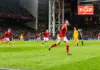

Watching the highlights of the Cruzeiro vs Atlético Mineiro brawl, one would think it was a scene from a wrestling match or a trailer for the Royal Rumble rather than a football match.
Punches were thrown, the flying kicks connected, players and staff piled into the chaos, and the situation quickly spiralled out of control, culminating in an astonishing record-breaking 23 red cards being shown as referee Matheus Delgado Candancan struggled to restore order in one of the most extraordinary scenes the Brazilian game has witnessed.
For football-loving fans, scenes like that are the last thing anyone wants to witness on a football pitch. Moments of anger should be channelled in a positive way to produce positive results, and violence should simply have no place in the sport.
From the very beginning of a player’s journey, one of the first lessons taught is respect – respect for the game, for opponents, for officials, and for the spirit of sportsmanship that should define football both on and off the field.
Yet the 2026 Campeonato Mineiro final will not be remembered solely for Cruzeiro lifting the trophy – a significant moment as it marked their first state title since 2019. Instead, the match will forever be remembered as the night when a fiery rivalry descended into a dark display of Brazil football violence.
Spectators watched on in disbelief as players’ emotions boiled over, an intense feud spiralled completely out of control, and a historic final descended into chaos, becoming the Brazilian match with the most red cards ever – overtaking the 1954 clash between Portuguesa and Botafogo which saw 22 red cards handed out.
Cruzeiro vs Atlético Mineiro Brawl – What Actually Happened?
After a swift counterattack from Cruzeiro, the move ended with a shot on goal that Atlético Mineiro goalkeeper Everson initially saved but failed to gather cleanly. He managed to secure the ball on his second attempt, although Cruzeiro midfielder Christian was also challenging for the ball, and what followed quickly turned the situation into chaos.
The key moment that sparked the Cruzeiro vs Atlético Mineiro brawl into life was when Everson lunged into a rugby-style tackle on Christian, who had got up and was moving back into position. The goalie later followed it up by driving his knees into the chest and head of the player already on the ground, sparking furious reactions from Cruzeiro players on the pitch, while substitutes and staff from the bench rushed toward the scene, turning the confrontation into a full-scale melee.
Within moments, what should have been a tense but competitive final went completely out of control, with 12 red cards handed out to Cruzeiro players and 11 going to Atletico Mineiro, setting the stage for one of the most extraordinary disciplinary crackdowns the game has ever seen.
Everson, who instigated the melee, ended up with a bleeding nose, a swollen lip, a black eye and a large swollen lump on his head.
What Disciplinary Actions Will Be Taken?
The referee’s report will be submitted to the Superior Tribunal de Justica Desportiva (STJD), and after review, the final and appropriate punishment will be handed out according to the Brazilian Code of Sports Justice (CBJD).
Individual Player Suspensions
Amongst the players involved in the brawl, anyone identified as an active participant will face severe personal penalties.
Physical Aggression
According to Article 254-A of the CBJD, any player found guilty of ‘practicing physical aggression’ against an opponent or official typically faces a suspension of 4 to 12 matches.
While this covers the sporting sanction, the incident can escalate to ‘Assault and Battery’ under the Brazilian Penal Code if the violence exceeds the inherent risks of the sport – which it did.
If the tribunal classifies specific actions – such as the slaps, flying kicks and punches – which crossed the limit and moved into the case of ‘serious physical aggression,’ they have the authority to exceed the standard 12-match ban, potentially resulting in an indefinite suspension or a referral to civil authorities for criminal prosecution which would happen in a regular court, completely separate from the football tribunal.
Players such as former Porto striker Hulk and goalkeeper Everson could find themselves under serious scrutiny. Both players, as well as Kaio Jorge and Christian (Cruzeiro) are at risk of missing a significant portion of the upcoming national season as they were fully involved in the Cruzeiro vs Atlético Mineiro brawl meaning they could face lengthy suspensions once the committee reaches a conclusion.
Club Fines
While the players face individual bans, both Cruzeiro and Atlético Mineiro could face more severe punishments as under Article 213 of the Brazilian Code of Sports Justice (CBJD). These include:
Loss of Field Mandate
Both clubs could be required to play a minimum of 10 matches away from their home stadiums, with future fixtures potentially relocated as far as 100km from their headquarters. In addition, those games could be played behind closed doors, meaning neither side would be allowed to have supporters in attendance.
Heavy Financial Fines
This is the most direct and realistic punishment likely to be handed down, as clubs are held strictly liable for the attitude and conduct of their athletes and staff under Brazilian sports law.
While the Superior Tribunal will determine the exact penalty following a formal hearing, standard fines for such high-profile violence typically cap at R$ 100,000 (Brazilian Reais) per club.
However, given the record-breaking nature of the Cruzeiro vs Atlético Mineiro brawl, which needed the intervention of the military police, experts predict the tribunal could increase the fees significantly higher than the standard maximum amount in a bold bid to set a disciplinary precedent and deter future violence in the Brazilian game.
Point Deductions
This is another possible outcome, but it is rare for this punishment to be given out as it is usually reserved for administrative errors such as the violation of the competition’s rules and regulations (e.g., fielding ineligible players or late salary payment).
Although it is not common, it is still a possibility as the Supreme Tribunal has the authority to intervene if they determine the violence “brought the sport into disrepute”.
If sanctions of that magnitude are imposed, then it would be a big blow to Cruzeiro and Atlético Mineiro’s 2026 Serie A campaign before it even gains momentum and could potentially leave both clubs at the base of the Brazilian league table.
A New Low for Brazilian Football
For years, the Brazilian league has been synonymous with footballing pandemonium, as it is a frequent occurrence for fierce rivalries to boil over into chaotic clashes that result in an abnormal number of red cards.
The Cruzeiro vs Atlético Mineiro brawl, is just the latest in a long history of such outbursts, but it has now set a staggering new benchmark for disorder, showcasing modern football toxicity where passion spills into hostility.
Hopefully, when the punishments start rolling out, they will serve as a strong deterrent for future clubs that might consider allowing such incidents to unfold.
Main Photo
Credit: IMAGO / Onzex Press e Imagens
Recording Date: 08.03.2026