

Winter’s chill is reshaping international football, influencing everything from game strategies to the benefits of home advantage to the outcomes themselves.
Consider a frigid March night in 2013. Commerce City, Colorado, was blanketed in snow. Players struggled to see the pitch boundaries, and the ball vanished into the drifts. The referee, undeterred by the weather elements, blew the whistle to commence play.
Ninety minutes later, the United States had triumphed, edging out Costa Rica 1-0. The game, forever known as the “Snow Clasico,” was a maelstrom of disorder, debate, and moments that would be talked about for years. More than anything, it underscored a basic reality of international soccer (as Americans call it): the game changes when the weather turns.
This isn’t a rare event. From continent to continent, and in every competition, matches played in the cold are altering tactical approaches, the advantage of playing at home, and even the results that determine who qualifies. Winter football is no longer a minor inconvenience; it’s a major factor. National teams are now actively preparing for it, fully aware of its influence on how they play.
When Climate Becomes the Extra Player
International football already compresses preparation time. Add freezing temperatures, icy surfaces, and unpredictable ball movement, and margins become even thinner. UEFA match data from recent European qualification cycles shows that games played in sub-zero conditions produce higher long-ball usage and a higher frequency of aerial duels, while overall pass completion drops by several percentage points compared to matches played in mild weather.
Cold conditions slow the game physically and mentally. Muscles tighten faster. Decision-making becomes riskier. Simple touches require greater concentration. In these environments, tactical discipline often matters more than flair.
The elements don’t just watch football; they play a role in it.
Nations Built for Winter Battles
Some teams have a leg up when the weather turns. Nations where local sports continue throughout the winter months tend to produce athletes accustomed to harsh conditions, both physically and mentally.
Scandinavia and the Benefits of Artificial Turf
Norway, Sweden, Finland, and Iceland regularly train and compete on artificial pitches designed for the cold.
Iceland’s impressive rise in the late 2010s wasn’t just about strategy; it was also about the infrastructure that allowed for year-round training in the cold. When the winter qualifiers come around, these nations aren’t making adjustments; they’re just sticking to their normal schedule.
Eastern Europe’s Traditional Fortress Mentality
Poland, Serbia, Ukraine, and Russia have long turned their winter home games into psychological warfare.
Packed stadiums, the chill in the air, and unforgiving playing surfaces all conspire to make life difficult for visiting teams. For years, winter home games in Eastern Europe have quietly influenced the standings.
READ MORE: Mexico vs Panama and Bolivia: Meaningful Experiments or Meaningless Friendlies?
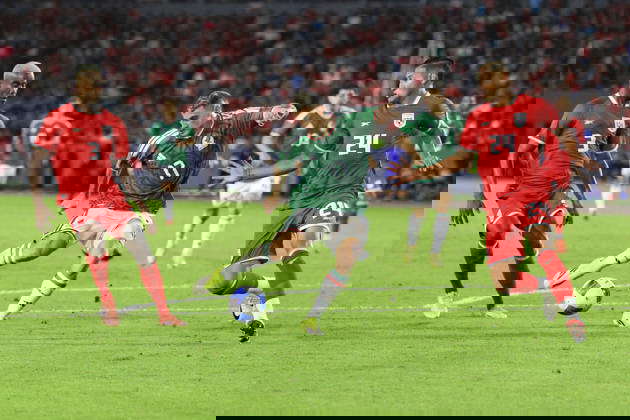
Tactical Adjustments: How Coaches Adapt to the Cold
Winter football has compelled international coaches to reconsider their tactical approaches. Direct play has taken precedence over possession. Cold pitches slow the ball and make its bounce less predictable. Numerous national teams have reacted by simplifying their offensive tactics. Early crosses, sweeping diagonal passes aimed at the flanks, and a strong emphasis on set pieces have all become standard practice.
Another key element is the focus on traditional forwards rather than false nines. This method minimises technical risk and amplifies territorial pressure.
Compact defensive blocks have replaced high pressing. Sustained pressure demands a lot of energy. When it’s cold, muscles tighten and fatigue sets in, increasing the risk of injury. Because of this, coaches often use mid-block defensive setups, focusing on being tight rather than aggressive.
Rotation isn’t just a good idea anymore; it’s essential. Cold weather speeds up the need for recovery. Nowadays, international managers are more likely to rotate full-backs, midfielders, and wide players during busy schedules.
Winter football is now a different beast, approached with scientific precision rather than just feeling.
Legendary Winter Matches That Changed the Game
History shows how the weather can change the outcome of international sports.
USA vs Costa Rica: ‘The Snow Clasico’ (World Cup Qualifier | March 22, 2013 | Commerce City, USA)
The blizzard turned the field into a desolate, icy expanse. Even with Costa Rica’s protests, the game went on. The United States adapted better, relying on physical play, a strong defence, and a straightforward strategy.
Clint Dempsey’s precise strike in the 16th minute was all it took for a 1–0 victory. The match sparked global debates about fairness, climate action, and the obligations of event organisers. The example clearly showed how weather conditions might directly affect fairness in competition.
Canada vs Mexico (World Cup Qualifier | November 16, 2021 | Edmonton, Canada)
Canada deliberately chose Edmonton, where temperatures plummeted to roughly -9°C. Mexico struggled to cope with the cold, while Canada played with remarkable vigour and drive.
The 2-1 victory was a crucial step towards qualification, and it proved that selecting a winter location had become a tactical decision rather than mere happenstance.
Russia vs Portugal (World Cup Qualifier | October 14, 2012 | Moscow, Russia)
Portugal’s traditional possession-based approach was disrupted by the frigid weather. Russia’s tight defensive structure and quick counterattacks earned them a 1–0 win, strengthening their qualification chances.
It highlighted a well-established truth: the advantage of playing at home in cold conditions is a significant factor at the highest level.
Winter Makes Home Advantage Stronger
Statistical examinations of qualification cycles indicate that home teams possess a discernible advantage during the winter months. These analyses reveal that teams competing at home experience a higher victory rate in cold-weather matches than in more temperate environments.
Multiple variables factor into this:
- Visiting teams often have insufficient time to acclimate to the cold.
- Pre-match training sessions are often curtailed.
- Travel-related fatigue exacerbates the effects of the cold.
- Home teams demonstrate superior familiarity with the playing conditions, thereby gaining a competitive edge.
National federations are now factoring in climate when choosing stadiums, favouring those that provide the best advantage.
Winter is now a crucial part of match preparation.
YOU MAY ALSO LIKE: Fantasy Football Matchweek 24: Buy, Sell, Injury Report

What the 2026 World Cup Tells Us About the Future
With North America hosting the next World Cup, cold-weather planning is becoming a worldwide concern. Several host cities experience winter temperatures during preparation periods and qualification windows, forcing teams to rethink long-term strategies.
For fans and analysts following international tournaments closely – including those tracking performance trends across major events such as the Olympics and World Cups – winter conditions are becoming part of pre-match evaluation. That’s why many readers now consult specialised resources such as https://bookmaker-expert.com/bookmakers/sports-betting/olympic/ to better understand how environmental factors, scheduling, and venue conditions influence odds movement and match expectations.
National teams are already making adjustments:
- They’re setting up training camps in colder climates.
- They’re choosing players who have played in winter leagues.
- They’re changing how they recover after games.
For some countries, being used to the cold could give them an edge in the tournament.
The Psychological Side of Winter Football
Cold weather affects mental preparation just as much as strategy.
Winter matches often bring:
- Rowdier, more fervent home crowds
- A more physical style of play
- Greater strain on visiting teams
Floodlights cut through the murk, the air is thick with breath, and supporters bundle up in scarves; winter football creates an atmosphere that can tilt the psychological balance. Mental toughness is now a crucial part of the game plan.
Final Thoughts
For a long time, cold weather was treated as bad luck. You showed up, froze a bit, played the match, and moved on. That mindset is gone.
Now, winter is something teams actively prepare for. Coaches plan around it. Players train differently. Federations think twice about where and when they host games. Small details – the surface, the temperature, recovery routines – suddenly matter a lot more than they used to.
And when you look back at snowy qualifiers and freezing night kickoffs, a simple pattern stands out. The teams that struggle are usually the ones caught off guard. The ones that do well are prepared, organised, and comfortable playing ugly football when conditions demand it.
In international football, where margins are thin and preparation time is limited, that difference can decide entire qualification campaigns. Winter doesn’t have to be an obstacle. If handled properly, it can be a weapon.
Main Photo
Credit: IMAGO / ZUMA Press Wire
Recording Date: 22.03.2013