
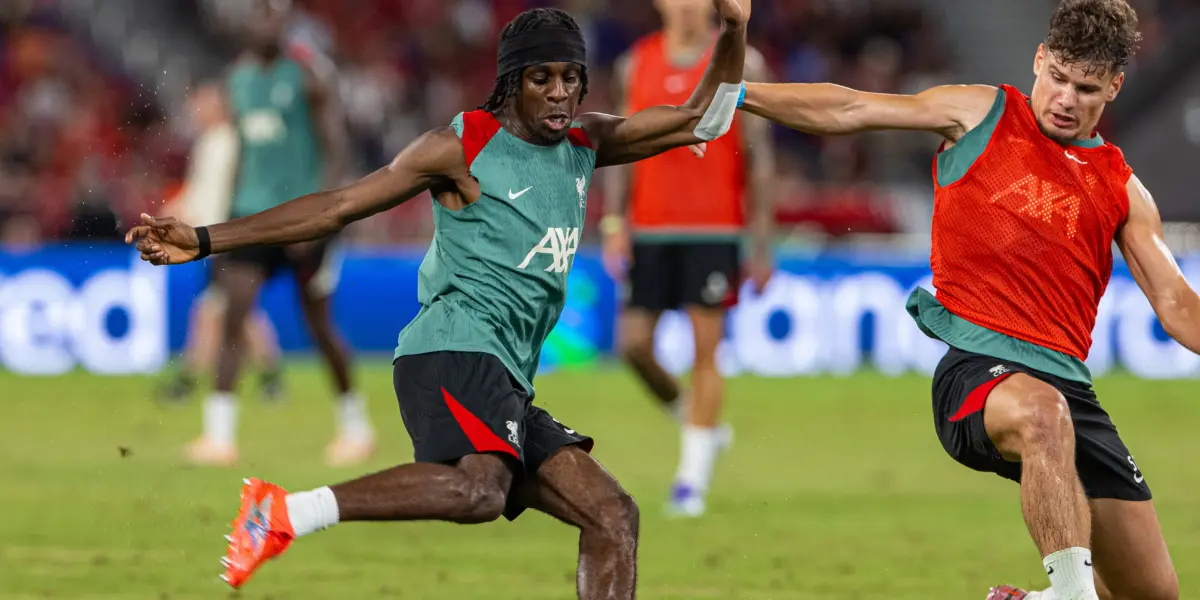
Ever since Jürgen Klopp transformed the club from 2015 onward, the Liverpool full-backs have stood as one of the defining features of his era — and that legacy, for the most part, survived his departure in 2023. Under the German, the full-back position evolved from a defensive afterthought into one of the club’s sharpest attacking weapons — supplying width, creativity, and a reliable outlet in the final third, with Trent Alexander-Arnold and Andy Robertson developing into world-class operators, racking up assists from deep and turning what used to be a purely defensive slot into a genuine creative hub.
Lately, that strength has started to look like a liability. It’s not entirely fair to pin the blame on Milos Kerkez and Jeremie Frimpong — a case can be made that they simply haven’t adapted yet to what new head coach Andoni Iraola demands from the role. Still, that is a problem Liverpool can’t afford to sit with. With an attacking unit assembled at a cost of roughly £420 million, one underperforming area of the pitch risks destabilising everything built around it. In a Premier League title race, that leaves little room for error; a structural weakness like this — left unresolved — could end up being the difference between contending and falling short.
Liverpool Full-Backs: Why Their Lack Of Balance Is Becoming Costly
When Liverpool full-backs push high up the pitch to act as primary creators, they naturally leave significant spaces behind them. This has always been part of the trade-off in the Reds’ approach, but the problem becomes more dangerous when the team loses possession without having enough players positioned to cover those areas.
Opponents are increasingly able to identify these spaces and attack them quickly on the counter. Rather than trying to play through Liverpool’s midfield, they can simply move the ball into the channels vacated by the advancing full-backs, forcing Liverpool’s defenders to turn and retreat towards their own goal. This creates another problem for Liverpool’s centre-backs. Players such as Virgil van Dijk may be forced to move across to cover the wide areas instead of protecting the centre of the pitch. The defensive midfielder can also be dragged towards the flank to provide additional cover, leaving fewer players protecting the central areas.
Once that happens, their defensive structure can become stretched; a move that initially begins with one full-back being caught high can quickly turn into a much bigger problem, with the centre-backs pulled apart, the midfield exposed and opponents finding more space between the lines. The attacking contribution of Kerkez and Frimpong is therefore not the problem by itself. The real issue is whether Iraola’s men have enough balance behind the ball to protect them when they move forward. If that protection is inconsistent, their greatest attacking weapon can become one of the easiest ways for opponents to hurt them.
Former Reds midfielder Danny Murphy has also been vocal about the issue, arguing that the Liverpool full-backs simply aren’t operating at the level the team needs in the final third — their end product, particularly in crossing and picking the right pass, falling well short of what the position demands.
It’s a sharp contrast to the standard set by Alexander-Arnold and Robertson, and one that, in Murphy’s view, isn’t likely to change no matter how hard the pair work. He said:
“The bigger problem is that the full-backs aren’t good enough at Liverpool. They are not good enough. They are not going to get better, it is not in them. They are 100mph. They are working hard but their level of crossing and choice of final pass is really poor.
“It looks worse for the Liverpool fans when you have been so used to seeing two of the best we’ve ever seen in Andy Robertson and Trent Alexander-Arnold, in terms of assists, quality and picking the final pass. They have brought in two full-backs, who aren’t as good. I think they are okay defensively, not brilliant, but they are okay.”
The Burden Of Creation For Kerkez And Frimpong
Another issue for Liverpool full-backs is the amount of creative responsibility they can carry when the midfield fails to provide enough invention. For years, the Reds could rely on their full-backs to create chances through overlaps, crosses, switches of play and progressive passing. However, when too much of the attacking responsibility falls on them, the team can become easier to read.
Opponents can focus their defensive attention on the wide areas, knowing that Liverpool will often look to Kerkez and Frimpong to progress the attack. This allows teams to stay compact, double up on the flanks, and force the full-backs into predictable passes or crosses. With the midfield not consistently sharing the creative burden, Liverpool can struggle to find alternative routes into the final third.
That ultimately makes the attacking quality of players like Alexander Isak, Florian Wirtz and Hugo Ekitike less effective. The problem is not a lack of attacking talent; it is that they need more players contributing to the build-up and chance creation so that opponents cannot simply shut down one of their main attacking outlets.
YOU MAY ALSO LIKE: Aston Villa Premier League 2026/27: From Summer Rebuild To Crisis But How Can They Turn It Around?
The Exhausting Demands Of Iraola’s System
The full-back position is arguably one of the most demanding roles in modern football. Players in that position are expected to bomb up and down the pitch for almost the entire 90 minutes, as failing to contribute at either end can leave their team exposed defensively or cause attacks to lose their momentum due to a lack of width and support.
The demands placed on Liverpool full-backs in an intensity-filled Andoni Iraola system make the role even more physically demanding. They are required to contribute heavily in both phases of play while repeatedly covering large areas of the pitch. Over time, that workload can take its toll, particularly during the latter stages of matches when fatigue can affect their defensive recovery, attacking runs and decision-making in the final third.
This was seen during Iraola’s time at his former club. While at Bournemouth, several of his campaigns followed a near-identical pattern — strong starts undone by fatigue and injuries as the season wore on. That fatigue can affect more than just their defensive recovery. When the legs begin to tire, the quality of their decision-making in the final third can also drop. Crosses may become less accurate, passes less precise and attacking runs less frequent.
At the same time, the Liverpool full-backs may be slower to react when the Reds lose possession, leaving the team vulnerable to quick transitions, and this becomes particularly important over a long season. If Liverpool want to remain competitive in the Premier League title race, they’ll need Kerkez and Frimpong to maintain both their attacking output and defensive discipline consistently.
Fans might argue that Alexander-Arnold and Robertson did it for years, but the intensity and demands of the role cannot simply be measured by how much ground a player covers. Both players were exceptional at balancing their attacking responsibilities with their defensive duties, while Liverpool’s overall system also provided them with the structure and protection needed to thrive. The challenge for the current Liverpool full-backs is finding that same balance in a new tactical setup without allowing the physical demands of the position to eventually affect their performances.
Extra Time Notes
Over the past couple of summer transfer windows, the Reds have invested heavily in adding firepower to their attack, but football is ultimately about how well every part of the team connects. You can have players such as Isak, Ekitike, Wirtz and Cody Gakpo in the squad, but if the build-up, width, defensive transitions and midfield coverage are not properly balanced, those attackers can still struggle to receive the ball in the positions where they can cause the most damage.
Liverpool’s recruitment has clearly prioritised attacking quality, but the full-back positions and the structure behind those attackers deserved just as much attention. Until that balance is found, Liverpool could continue to look like a side with plenty of individual quality but lacking the stability and cohesion expected of a team competing in the Premier League title race.
More Premier League News
Noni Madueke Form: How Can Arsenal Winger Rediscover His Best Form?