

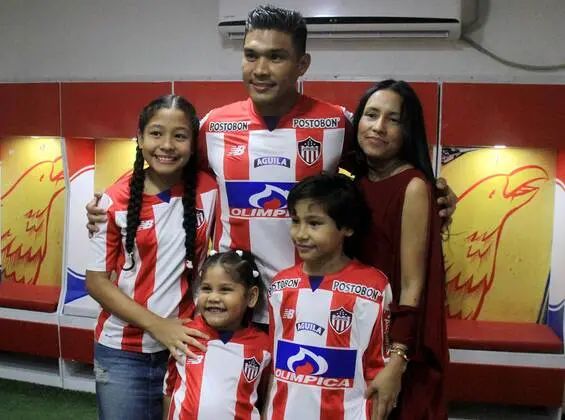
When the final whistle blew in Barranquilla, Colombia on Monday night, referee Wilmar Roldán walked across the pitch and handed his golden whistle to Teó Gutiérrez. Roldán has spent two decades refereeing some of the biggest matches in South American football. Teo has spent much of his career arguing with referees, and Gutierrez’s career ended with a moment of mutual respect.
The 41-year-old had already given the Junior de Barranquilla supporters one final moment to remember. Coming on at half-time against Deportivo Cúcuta, Gutiérrez needed just five minutes to score, finishing Bryan Castrillón’s pass with his right foot to put Junior 2-0 ahead. Off came the shirt. He took the inevitable yellow card, then laid his jersey on the grass with his name facing the stands. It was his 107th goal for Junior, and his last at home.
Teó Gutiérrez: El Loco Bonito Gets His Barranquilla Goodbye
The supporters had started their farewell much earlier. In the 29th minute, a tribute to his shirt number, the Romelio Martínez rose to applaud him. Flares filled the stands with smoke, forcing a temporary stoppage. One banner captured the mood: “Árbitro no pites el final que Teo se nos va.” Referee, don’t blow the final whistle. Teo is leaving us.
Afterwards, Gutiérrez was asked how he wanted to be remembered. “Ese loco bonito, que hace respetar la camiseta.” That beautiful madman who made people respect the shirt. Anyone who followed his career knows he could only tell the truth.
Teó Gutiérrez: The Loco Years
You cannot tell Teo’s story without going back to Argentina. In April 2012, Racing Club faced Independiente in the Clásico de Avellaneda. Gutiérrez scored Racing’s only goal in a 4-1 defeat, then got himself sent off for insulting the referee. It was his fourth red card for the club.
Things somehow got worse in the dressing room. Captain Sebastián Saja confronted him, a fight broke out, and teammate Giovanni Moreno suffered injuries to his face. Then came the incident that Argentine football supporters still talk about. Gutiérrez pulled what appeared to be a gun from his bag. He later insisted it was a toy. Others described an air pistol that looked real enough to frighten the players around him. “Ahora sí. Vengan de a uno.” Now, come one at a time. Teo left the stadium in a taxi and never played for Racing again.
It was an extraordinary way to end a spell at one of Argentina’s biggest clubs, even by his standards. For some supporters, that incident would define him forever. But it was never the whole story.
From Racing Controversy to Rey de América
Two years after leaving Racing, after modest success at Cruz Azul in Mexico, Teó Gutiérrez was named Rey de América, the best footballer playing in the Americas. At River Plate, he became one of the most dangerous forwards on the continent. He helped the club win the Liga Argentina, Copa Sudamericana, Recopa Sudamericana and the 2015 Copa Libertadores.
For Colombia, he was an important part of José Pékerman’s national team, playing alongside Radamel Falcao during the qualification campaign that ended the country’s 16-year World Cup absence. His goal in Colombia’s remarkable 3-3 comeback against Chile in Barranquilla, his own city, helped secure qualification for Brazil 2014. With Falcao injured for the tournament, Gutiérrez led the line at the World Cup. He scored against Greece in Colombia’s opening match, a 3-0 victory in Belo Horizonte, as the country began its most successful World Cup campaign.
That was Teo at his best. He could hold the ball up, bring teammates into play, create something from very little and finish chances that other forwards might waste. He was also capable of losing his temper at almost any moment. Both things were true. The trouble sometimes overshadowed the football, but it should never obscure how good he was.
Teo Returns Home to Junior
There were spells with Sporting CP in Portugal and Rosario Central in Argentina before Gutiérrez returned to Junior, the club of his youth, in 2017. For all the trophies and controversy abroad, Barranquilla was always home. After Monday’s match, he explained that his grandmother had been the biggest reason behind his return. “Se lo dedico a mi abuela que está en el cielo, que fue la más importante para que yo volviera en el 2017.” He dedicated the goal to his grandmother, who had passed away and who had encouraged him to come home.
And what a return it turned out to be. Gutiérrez won seven titles with Junior, including consecutive Colombian league championships in 2018 and 2019. His 107 goals put him third on the club’s all-time scoring list, behind Iván René Valenciano and Carlos Bacca. Those are some serious names to be mentioned alongside in Barranquilla.
There was even time for another Colombian championship. Gutiérrez helped Deportivo Cali win the Colombian league in 2021, giving the club’s supporters their own memories of the man who had spent so many years tormenting opponents. Across his career, he played for 12 clubs, scored 184 goals and collected 15 trophies. But it was at Junior where he belonged.
He grew up in La Chinita, a working-class neighbourhood of Barranquilla, and became one of the most recognisable footballers the city has produced. He told a Junior fan podcast that his bond with the club was shaped by a 2008 win where he helped save the club from relegation by scoring in the rain.
He was never a polished public figure, and nobody would mistake him for one. Junior supporters loved him anyway, often because he was authentic.
Read More: “I never thought I was going to play until I was 41 years old”: Teo and the reflections of his farewell in Junior
The Last Dance in Barranquilla
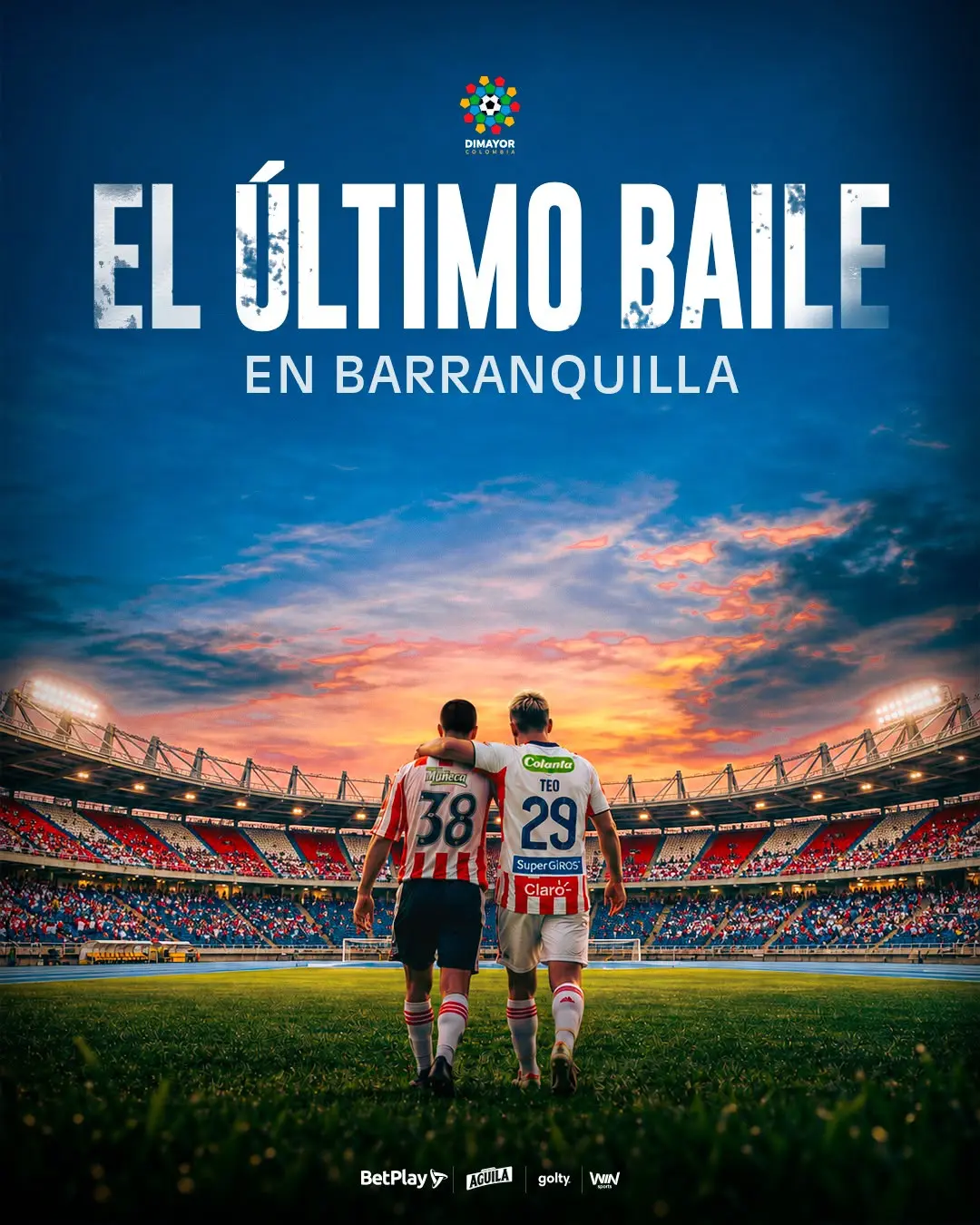
It’s been a disappointing season for Junior, defending consecutive Liga Betplay Dimayor titles, they were a non-factor in the 2026 Copa Libertadores, and have already been eliminated from this year’s title chase.
There is still one league match to play, with Junior travelling to face Deportivo Pasto. Gutiérrez also has an official farewell scheduled for December 19 at the Estadio Metropolitano in Barranquilla, an event billed as The Last Dance, that testimonial match will feature players from the 2014 River Plate and 2018 Junior squads. But Monday felt like the real goodbye. He had scored one more goal in front of his supporters, taken one more yellow card for celebrating it and received a referee’s whistle as a parting gift.
Afterwards, he promised the Junior supporters that although his playing days were ending, he would still be around. “Van a tener un gran hincha acá.” You are going to have a great fan here now.
Colombian football has produced more talented players than Teófilo Gutiérrez. Very few have had quite the same relationship with their hometown. He was a Libertadores winner, a World Cup goalscorer, a Colombian champion and the man who once pulled a gun out in a Racing dressing room. You cannot leave any of that out and still tell his story properly. Barranquilla knew all of it. The city celebrated him anyway.
El loco bonito, one of the only players who could ever carry that name.
Extra Time Notes
Teófilo Gutiérrez leaves behind a remarkable career in South American football. His 107 goals for Junior place him third in club history behind Iván René Valenciano (166) and Carlos Bacca (135), while his seven titles include the 2018 and 2019 Colombian league championships. He also won the 2015 Copa Libertadores with River Plate and was named Rey de América in 2014. For Colombia, he earned 51 caps and scored 15 goals, including one at the 2014 World Cup. His career took him through Argentina, Portugal and several Colombian clubs, but Barranquilla was always where he wanted to finish. His official farewell match, The Last Dance, is scheduled for December 19 at the Metropolitano in Barranquilla, Colombia.
Main Photo Credit: Imago Images/Agencia EFE
More Americas Football Coverage
Unpaid, Exiled, and Still Standing: The Impossible Season of Cali Colombia’s Football Clubs
Americas Football Round-Up: Independiente del Valle and Colo-Colo Crowned Champions
“I’m Already Rich, I Don’t Need to Run”: The Strange Story of Colombia’s Lost Striker Jhon Duran
November International Preview: CONMEBOL Friendlies and 2026 CONCACAF Nations League Quarterfinals


