
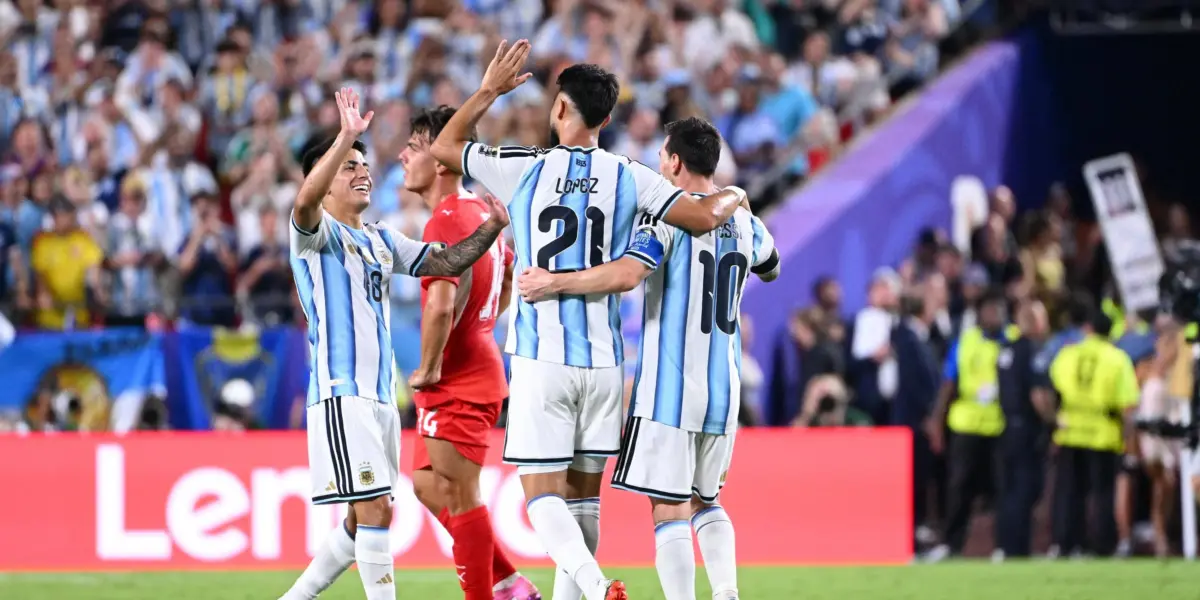
The La Albiceleste booked their place in the World Cup semifinal with a 3-1 victory over Switzerland in the quarterfinals. However, looking back, the Argentina 2026 World Cup campaign has been built on a blend of quality and good fortune.
While luck often plays a role in football, several of Argentina’s performances have left fans unconvinced, raising questions over whether this squad has what it takes to reach consecutive World Cup finals and become the first nation since Brazil in 1958 and 1962 to achieve the feat.
Lionel Scaloni’s side have, on several occasions during this World Cup, struggled to close out matches despite taking control.
Argentina has also appeared overly reliant on Lionel Messi to deliver in decisive moments, raising concerns about where the goals and creativity would come from if he is effectively contained.
In addition, Lionel Scaloni’s tactics and choice of personnel have come under scrutiny, with some of his decisions allowing opponents to dictate large spells of play and making Argentina look second best for significant periods of matches.
What has made fans even more concerned about Argentina’s performances is the fact that they have struggled against opponents they would normally be expected to defeat comfortably.
Take Cape Verde and Egypt, for example. The Cape Verdeans came within touching distance of producing one of the biggest upsets in FIFA World Cup history, forcing Argentina into 30 minutes of extra time before the reigning champions finally found the decisive goal to seal their place in the next round.
Against Egypt, Lionel Scaloni’s side once again looked vulnerable, requiring a dramatic comeback that saw them score three times in the final 11 minutes to secure qualification.
Even in their quarter-final clash against Switzerland, Argentina failed to produce the commanding performance many expected.
Despite playing against 10 men from the 72nd minute following the controversial dismissal of Swiss striker Breel Embolo for simulation, Lionel Scaloni’s side still needed extra time to secure a place in the last four.
Rather than taking control after gaining the numerical advantage, Argentina continued to look vulnerable and lacked the cutting edge required to put the contest beyond doubt in normal time.
For a team with genuine ambitions of winning the FIFA World Cup 2026, needing 120 minutes to overcome a 10-man Switzerland only reinforced concerns about their ability to deal with stronger opposition in the latter stages of the tournament.
Performances like these have inevitably raised doubts about Argentina’s World Cup chances.
If they have struggled so much against less-fancied opponents, many fans fear what could happen when they face one of the tournament’s heavyweights.
With England waiting in the World Cup semi-final, those concerns have only intensified.
1) Argentina 2026 World Cup: Defending Direct Pace And Vulnerability On The Counter
A major reason why the Argentina 2026 World Cup campaign looks vulnerable is due to the fact that Lionel Scaloni’s side have looked vulnerable against teams that play with directness, speed, and purpose in transition.
The Argentine national team is blessed with technical players who are comfortable controlling possession and dictating the tempo. However, the downside of this is that they leave space behind whenever they commit numbers forward in search of goals.
This weakness has been evident on several occasions throughout their campaign. Whenever possession is lost in advanced areas, the midfield has struggled to recover quickly enough, and this has left gaps, making the midfield exposed to swift counter-attacks.
Egypt, in particular, demonstrated how Argentina’s backline can be breached with pace and direct attacking play.
Rather than sitting deep for the entire match, the Pharaohs consistently targeted the spaces left behind by Argentina’s advancing players, using quick vertical passes and rapid transitions to devastating effect.
Their second goal was a perfect example. A swift counter-attack from deep allowed Haissem Hassan to drive directly at the Argentine defence, causing problems for Nicolás Tagliafico and Lisandro Martínez before squaring the ball for Mostafa Ziko to double Egypt’s lead.
A similar sequence also led to what would have been another Egyptian goal. Once again, Hassan’s direct running exposed Argentina’s defensive structure and left the backline scrambling, although the effort was ultimately ruled out due to a foul in the build-up.
These moments highlighted a recurring weakness in the Argentina World Cup campaign.
Whenever opponents attack with speed and purpose, particularly in transition, Lionel Scaloni’s side can be caught out defensively — a vulnerability that stronger teams in the World Cup knockout stage will undoubtedly look to exploit.
Now, their next opponent, England, possesses explosive wide players and midfielders capable of turning defence into attack within seconds.
For a team widely regarded as one of the 2026 World Cup favourites, if Lionel Scaloni’s tactics continue to leave space behind the full-backs, they may find themselves punished by opponents with greater attacking quality than those they have faced so far.
2) Severe Late-Game Fatigue And Knockout Fatigue
Having a trusted core of players is essential for any manager, but knowing when to rotate the squad and adapt tactically is equally important in a tournament as demanding as the FIFA World Cup.
When the Argentina World Cup squad was announced, there was widespread excitement over the inclusion of promising young talents such as Valentín Barco, Nico Paz and Giuliano Simeone.
Their energy, pace and willingness to press offered Lionel Scaloni valuable options to inject fresh legs into the team as the tournament progressed.
However, despite earning a place in the squad, these players have largely remained on the sidelines, with Scaloni showing a clear preference for his experienced starters.
While that loyalty has its advantages, it has also limited Argentina’s ability to refresh the team during physically demanding matches.
Introducing these younger players at key moments could provide the team with the intensity, dynamism and fresh energy needed to maintain their level throughout games.
However, Lionel Scaloni has shown little willingness to make significant changes to his starting lineup.
Despite signs of physical fatigue growing within the squad, the Argentine manager has continued to rely heavily on his experienced core, with several key players featuring in almost every minute of the tournament.
While that consistency has helped preserve cohesion and understanding, it has also increased the physical burden, raising concerns over whether they can maintain the same intensity as their campaign enters its most demanding stage.
The effects of fatigue have become increasingly noticeable during the latter stages of matches, as Argentina have struggled to sustain the same intensity they display in the opening hour, often allowing opponents to grow into games as their energy levels begin to drop.
Their pressing becomes less coordinated, recovery runs slow down, and the spaces between midfield and defence become much easier to exploit.
The performance of fatigued players does not just drop drastically — their decision-making would also be impacted.
Tired players are more likely to lose concentration, react a fraction slower, misplace passes and make defensive errors under pressure.
At this stage of the World Cup, the smallest mistake can end a team’s tournament, as those lapses can be the difference between reaching the final and heading home.
With their next game against England, this is where Argentina’s World Cup chances could face their biggest test yet.
Thomas Tuchel’s team arrive in the semi-final with a younger squad and fewer signs of physical wear, giving them a potential advantage in terms of energy and intensity.
If the match remains level entering the closing stages, the Three Lions may be better equipped to increase the tempo and exploit Argentina’s tiring legs.
MORE FOR YOU: World Cup 2026 France vs Spain: Three Key Factors, Predicted Lineups And Team News
3) Severe Over-Reliance On Lionel Messi’s In-Game Brilliance
For many football fans around the world, the GOAT debate was settled years ago, with Lionel Messi widely regarded as the best player in the world.
Even at 39, Messi remains the heartbeat of Argentina, continuing to produce moments of individual brilliance capable of changing the course of a match.
However, while the Inter Miami forward’s enduring quality remains one of the team’s greatest strengths, it has also become one of their biggest concerns.
Throughout Argentina’s 2026 World Cup campaign, the team has shown an increasing dependence on their captain, with too much of their attacking creativity and match-winning responsibility resting on his shoulders.
Against the stronger teams remaining in the tournament, that level of reliance could prove to be a significant weakness rather than a strength.
One recurring pattern throughout this World Cup campaign has been the tendency of players to immediately look for Messi whenever the team comes under pressure or struggles to break down a compact defence.
Rather than taking responsibility themselves, many of his teammates’ next action is to seek their captain, expecting him to produce the decisive pass, score the crucial goal or create something out of nothing.
This growing dependence has inevitably raised questions about Argentina’s World Cup chances and whether the team would have progressed this far in the tournament without their talisman.
While Messi remains capable of deciding games on his own, expecting a 39-year-old to carry such a heavy creative burden in every knockout match is unrealistic.
The contrast with the 2022 World Cup is particularly striking. Four years ago, Argentina’s success was built on collective contributions across the pitch.
Players such as Enzo Fernández, Julián Álvarez, Alexis Mac Allister and Ángel Di María consistently stepped up in key moments, ensuring that the attacking responsibility was shared rather than resting solely on Messi’s shoulders.
That balance made the team far less predictable and much more difficult for opponents to defend against.
This time, however, the attacking burden appears to have shifted almost entirely onto Messi.
Julián Álvarez and Lautaro Martínez have both struggled to consistently influence matches, whether due to inconsistent form, fitness concerns or wastefulness in front of goal.
As a result, Messi has repeatedly been forced to drop deep into midfield to collect possession, dictate the tempo, initiate attacks and, more often than not, finish them himself.
He also carries the added responsibility of delivering dangerous set-pieces and producing moments of individual brilliance whenever Argentina need inspiration.
The downside of this approach is that it makes Lionel Scaloni’s tactics increasingly predictable.
Opposing managers understand that restricting Messi’s influence dramatically improves their chances of containing Argentina.
As a result, many teams have assigned multiple players to man-mark him, crowd the spaces he occupies, cut off his passing lanes and deny him time on the ball, forcing other Argentine players to become the primary creative outlets.
Whenever that strategy has been executed successfully, Argentina’s attack has looked surprisingly blunt.
The movement becomes slower, combinations lose their sharpness, and attacking sequences become far more predictable because too many players wait for Messi to produce a moment of magic instead of taking the initiative themselves.
If this pattern were to continue against England, there is a high chance that Argentina’s World Cup hopes of reaching another final could ultimately depend on whether their supporting cast is prepared to step out of Messi’s shadow and shoulder more of the attacking responsibility.