
Last Monday, millions of Colombians had their lives altered forever by a 7.5 magnitude earthquake that struck the western part of the country. Cali, Pereira, Manizales, Choco State, Valle del Cauca, and Buenaventura were among the cities and regions seriously impacted by the quake.
While international aid from charities and governments has supplemented the relief efforts of Colombia’s national and local governments, one of the most important forces on the ground has been Colombian football. Supporter groups, active nad former players, coaches, and clubs have mobilized across the country, collecting supplies, clearing rubble, raising money, and making sure aid reaches people who have lost homes, loved ones, and are in need of basic necessities.
For all of the problems and controversies that surround modern football, the response has been a powerful reminder of the role the sport can play within its communities.
All Dimayor Clubs Organize Relief Efforts
Four Liga BetPlay Dimayor clubs were directly impacted by the earthquake: Deportivo Cali, America de Cali, Once Caldas, and Deportivo Pereira. Yet the response has gone far beyond those four clubs, becoming a league-wide effort to support Colombia’s national earthquake response.
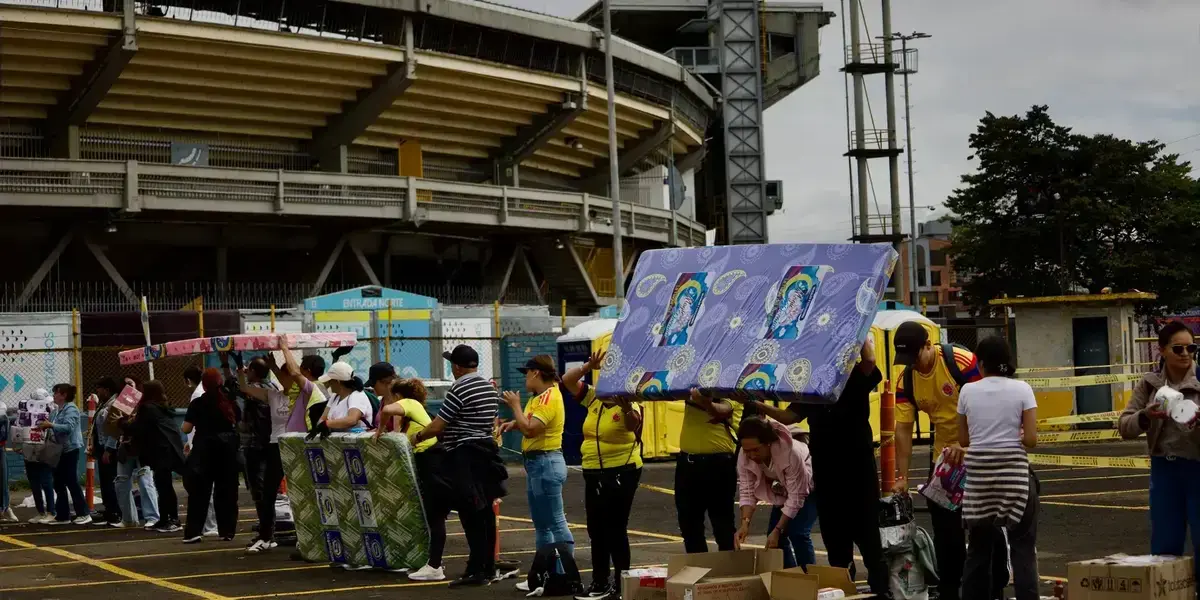
Professional football in Colombia is set to return later this week after some scheduling changes, while both Santa Fe and Deportes Tolima have South American cup clashes to play. In the absence of regular matches, however, stadiums, club stores, and community gathering spots for supporter groups became donation centers.
Supporter groups, including the sometimes controversial barra brava (ultras), have worked alongside clubs and players to collect and deliver truckloads of humanitarian supplies.
At El Campin stadium in Bogota, 933 tons of aid was collected over the weekend. Millonarios supporters and players worked together at the drive, with Millonarios forward Rodrigo Contreras telling the media:
“Sport has to take a back seat; right now, no one is in the right frame of mind to think about a football match.”
Santa Fe organized its own effort in Bogota. Hugo Rodallega, Iván Scarpeta, and Daniel Torres were among those who helped load aid trucks at the Casa Cardenal, the club’s official team store.
In Manizales, Once Caldas supporters went beyond collecting donations. As reported by La Patria, supporters physically helped remove earthquake debris around the city. Once Caldas also collected 7,800 grocery, hygiene, and children’s kits from supporters.
The efforts in Pereira and Cali have had an equally personal touch.
Walmer Pacheco, the captain of Deportivo Pereira, arrived in the damaged city and immediately went into the streets to help remove rubble and assist earthquake survivors. His actions prompted a viral post praising the captain for traveling from Barranquilla to Pereira, organizing donations, and then putting on gloves to help those affected.
“His name is Walmer Pacheco. He is from Barranquilla and is the captain of Deportivo Pereira, a team from the city that bears the same name and which was greatly affected by the earthquake in Colombia. As soon as he heard about the earthquake, Walmer organized a collection center in Barranquilla to collect donations. He went in his vehicle to Pereira and as soon as he arrived, he put on gloves and began to help remove debris to find survivors. He could well have stayed at his house in Barranquilla and there he is, on the streets of Pereira, helping his people. This is a captain.”
Pacheco was not the only Deportivo Pereira figure to step up. Manager Arturo Reyes was moved to tears discussing his relationship with the club and the city, telling Win Sports, the Liga Dimayor broadcaster that has also been encouraging donations:
“After becoming champion I spent a year and a half in front of the television and no one called me.” “Pereira opened the door for me and here I am.”
The response has also crossed one of Colombian football’s fiercest rivalries. America de Cali and Deportivo Cali announced a joint campaign, stating:
“Today there are no colors, no rivalries. There is solidarity, there is union, and there is a people that needs us.”
Deportivo Cali manager Rafael Dudamel added:
“Let’s all put our hands on our hearts and help those who need it today.”
America de Cali ultras were subsequently seen unloading aid trucks in Buenaventura.
While Medellin was not heavily impacted by the earthquake, supporters of both Atletico Nacional and Independiente Medellin also joined the relief effort. Independiente Medellin used its official team store as a donation center.
Atletico Nacional ultras were seen singing and chanting as they packed boxes and loaded trucks of relief supplies headed south toward the affected areas.
It is easy to talk about football being more than a game. In Colombia this week, supporters and clubs have provided a tangible example of what that actually means.
Colombian Footballers Organize Charity Matches and Make Personal Donations
The response has not been limited to supporters. Colombian footballers, both current and retired, playing domestically and abroad, have also become major drivers of the relief effort.
Leonardo Castro of Millonarios spent a significant period of his career living and playing in Pereira. He broke down in tears after organizing three trucks of aid for the stricken city.
Castro told Win Sports:
“Yesterday’s tears were not of sadness, but of great joy. The truth is, my wife and I didn’t think we were going to send three trucks and I think we did it with a lot of love. This is a little bit of the love we have for Pereira.”
Over the weekend, Colombian players abroad also used their platforms to raise awareness.
Camilo Duran scored for Celtic and revealed an undershirt reading “Fuerza Colombia.”
Cucho Hernandez and Nelson Deossa at Real Betis in Spain sat down and made a joint appeal for aid, speaking about the solidarity of the Colombian people.
Kevin Viveros, one of the top goalscorers in Brazil with Athletico Paranaense, is from Buenaventura. His club wore Colombian flag patches on its jerseys this weekend, while Viveros personally donated money to help the city.
Viveros told Caracol:
“I am in constant contact with people there to see who needs supplies. I have already sent some aid and hope it helps. I am waiting for additional aid to arrive from Cali. This is a time for us to support one another; even the smallest contribution makes a huge difference.”
Jhon Arias, who plays for Palmeiras in Brazil, also acted immediately. Working with his wife, he sent a plane carrying aid and doctors to Quibdo in Choco State, the epicenter of the earthquake.
Arias is from Choco, and his response has been so prominent that many Colombians have called for him to become the next captain of the national team.
The football community is also turning its attention toward longer-term reconstruction.
At least two charity matches will take place this week. On Wednesday, Atletico Nacional will host a friendly against Once Caldas in Medellin, with proceeds going to charity.
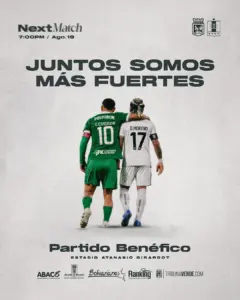
Then, on August 21, Bogota’s El Campin will host “Let’s Lift Up Colombia”, a legends match featuring the likes of Radamel Falcao, Mario Yepes, and Rene Higuita.
Football Has a Role to Play in Colombia’s Recovery
Recovering from a natural disaster on the scale of what Colombia, (and Venezuela last month), experienced will be an ongoing effort. The return of professional football later this week will provide a welcome sense of normality, but the needs of those affected by the earthquake will continue long after the matches resume.
There is a tendency in modern football for clubs, players, and supporters to feel increasingly disconnected from one another. Players are transferred across countries, clubs operate as global brands, and supporters can sometimes feel like customers buying an entertainment product rather than members of a community.
For a few days in Colombia, those divisions have largely disappeared.
Rivals have worked together. Ultras have packed boxes. Players have loaded trucks. Captains have cleared rubble. Former stars have returned to the field to raise money. And footballers playing thousands of miles from home have used their platforms and personal resources to help the places they came from.
Football cannot rebuild every home or replace every life lost. It cannot solve the enormous challenges Colombia faces in the aftermath of a disaster of this scale.
But it can bring people together, organize communities, raise money, and remind people that they are not facing the aftermath alone, and that brighter days are ahead.
In moments like these, that matters. It truly takes a village, and Colombian football has shown that it is willing to be part of that village.
Main Photo Credit: Smartframe Images