
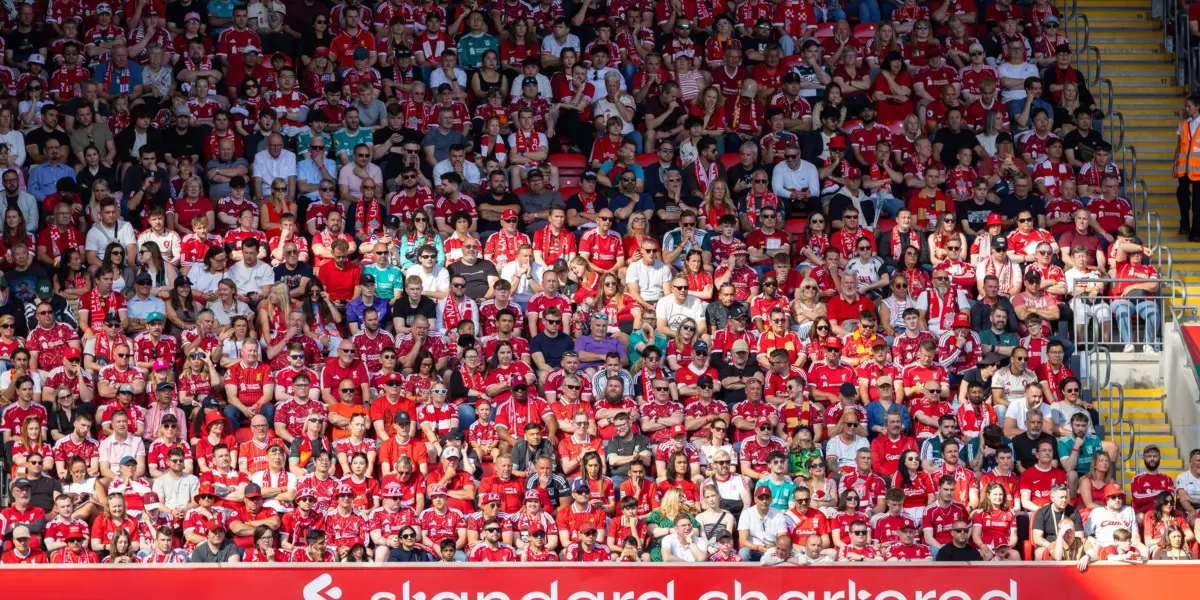
Walk into Anfield on a European night, and you will understand within 30 seconds why the Liverpool fanbase is such a special group of fans.
Before a ball is kicked, before a single passage of play has unfolded, the noise is already doing something to your chest. It isn’t just loud, it is directional — an atmospheric pressure that moves from the stands to the pitch like weather. Liverpool supporters don’t watch football; they participate in it.
That feeling doesn’t happen by accident, and it doesn’t sustain itself across generations without a genuine foundation. The Liverpool fanbase is widely regarded as one of the most passionate, most vocal, and most culturally embedded in world football — and there are specific, identifiable reasons why that is so.
Some of them are historical, some are geographical, some are bound up in tragedy and how a club and its city responded to it, but all of them matter.
Liverpool Fanbase: A City That Made The Club Its Own
To understand Liverpool supporters, you first have to understand Liverpool. The city has a particular relationship with its football club that goes beyond the normal bonds of local pride.
Liverpool spent much of the latter 20th century absorbing the economic consequences of deindustrialisation, port decline, and sustained political neglect.
During the 1970s and 1980s, as working-class communities across the north of England felt the full force of economic restructuring, the football club became something larger than a sporting institution; it became a vehicle for civic identity — a way of asserting collective worth in the face of external dismissal.
That context shaped the culture of support from the ground up. Supporting Liverpool wasn’t primarily a leisure activity; it was a statement of belonging. The songs, the scarves, the insistence on filling the ground and making noise regardless of the scoreline — these weren’t affectations borrowed from somewhere else. They were expressions of a community that had learned, through hard experience, that solidarity wasn’t optional.
The club’s extraordinary run of success in the 1970s and 1980s — 18 league titles, four European Cups, a period of dominance that made Liverpool the most feared side on the continent — reinforced the bond between city and club in ways that outlasted the trophies themselves.
Success at that scale becomes part of a place’s self-understanding. It doesn’t fade when the results stop coming; it becomes the standard, the reference point, the thing the next generation inherits, whether they were there for it or not.
For Liverpool supporters who engage with the club from further afield — across Australia or the US — online communities and platforms have become central to that experience.
The appetite to feel connected to the club between matches, to discuss, analyse, and share the experience, is enormous. Plenty of those supporters also seek out entertainment options that keep them engaged on matchdays; sites that also offer bonuses like the Hidden Jack no deposit bonus have tapped into exactly that overlap between football fandom and online engagement, offering ways to extend the matchday experience beyond the 90 minutes.
Liverpool Fanbase: Anfield And The Atmosphere That Changed Football
Grounds tell you a great deal about fanbases, and Anfield is one of the most storied football venues in the world.
The stadium has a particular quality on big nights that managers, players, and journalists have been trying to describe accurately for 60 years — and largely failing, because it resists description.
Jürgen Klopp, a man not short of words, called it “the most emotional place in football” after his first exposure to it, and that was before his team had even kicked off.
The Kop is central to this. The Spion Kop end has been a defining feature of English football culture since the early 20th century, and it gave its name to standing terraces at grounds across the country.
At its peak, it held over 28,000 people on a single terrace, and the culture it generated — the wit, the songs, the spontaneous choreography of a mass of people responding to events in real time — influenced how football supporters understood themselves and their role.
What the Kop established, and what Liverpool supporters have maintained even as the terrace became all-seater, is the idea that the crowd is a participant rather than an audience.
The infamous comeback against AC Milan in the 2005 UEFA Champions League final, where Liverpool recovered from 3-0 down at half-time, is partly remembered as a story about what happens when a crowd collectively refuses to accept that a match is over.
The atmosphere in Istanbul that night, generated partly by the travelling support, became part of the explanation for what followed on the pitch.
You can argue about how much atmospheres genuinely affect results, but Liverpool supporters have made that argument in their favour across decades.
Liverpool Fanbase: Tragedy, Resilience, And The Hillsborough Factor
Any serious account of the Liverpool fanbase has to address Hillsborough.
On 15th April 1989, 97 Liverpool supporters died in a crush at Sheffield Wednesday’s ground during an FA Cup semi-final, and it remains the deadliest stadium disaster in British football history.
What followed — a decades-long campaign by families and survivors against a narrative that falsely blamed Liverpool supporters for the disaster, the exposure of a systematic cover-up involving South Yorkshire Police and elements of the press, and the eventual inquest verdict of unlawful killing in 2016 — shaped the fanbase in ways that are impossible to overstate.
The fight for justice was not won quickly or easily; it took 27 years, extraordinary tenacity from families who refused to be silenced, and eventually a shift in institutional and public opinion.
The effect on the Liverpool fanbase is a kind of collective moral seriousness that sits alongside the passion. There is a wariness of authority, a sensitivity to how the club and its supporters are portrayed in the national media, and a fierce protectiveness over the club’s identity and history.
When Liverpool supporters sing “You’ll Never Walk Alone,” it carries weight that goes beyond football. It is a statement of communal solidarity that was forged in grief and tested over decades of institutional resistance.
YOU MAY ALSO LIKE: Liverpool’s Best Players From 2025/26 Premier League
Liverpool Fanbase: The Global Fanbase And Its Local Roots
Liverpool is one of the most supported clubs in the world. Estimates of their global following run to 100s of millions, with significant supporter communities across Scandinavia, South-East Asia, Australia, and North America.
That scale of international support raises a question that’s worth engaging with honestly: Does a massive global fanbase dilute the intensity of the core support, or does it amplify it?
In Liverpool’s case, the evidence suggests the latter — at least in terms of Anfield itself. The club’s local and regional support base has remained remarkably resistant to the kind of detachment that afflicts some clubs whose commercial success has outpaced their connection to place.
The city is small enough, and the club’s cultural embeddedness deep enough, that Anfield never became a tourist trap full of passive observers.
The songs, the rituals, the collective expectation of genuine noise — these were maintained by a core that understood what the ground was supposed to feel like and insisted on that standard.
Liverpool Fanbase: Jürgen Klopp’s Era And The Reconnection Of A Generation
Jürgen Klopp’s tenure from 2015 to 2024 deserves specific attention because it did something rare: it brought a new generation of supporters into genuine emotional ownership of the club without displacing the history that came before.
Klopp arrived at a club that had last won the league title in 1990 and had spent 25 years accumulating near-misses, painful finals, and the particular ache of sustained expectation without fulfilment.
His response to that was not to manage expectations downward. It was to build something — a style of play, a culture, a relationship with the Liverpool supporters — that made the waiting feel purposeful rather than merely frustrating.
The 2019–20 Premier League title, Liverpool’s first in 30 years, was an event that transcended sport for much of the city.
The scenes outside Anfield, the images of Liverpool supporters gathered at the ground during a season played behind closed doors due to the pandemic, said something about what that particular piece of silverware meant. It wasn’t just a trophy; it was the closing of a chapter that had been left open for a generation.
Liverpool Fanbase: What Makes Liverpool Supporters Different
Passion alone doesn’t distinguish Liverpool from other major clubs. Manchester United supporters are passionate, and Barcelona’s Camp Nou can generate its own intensity.
The specific combination of factors that makes the Liverpool fanbase distinctive is the depth of the historical and cultural context behind the emotion.
Most fanbases support their club because it’s local, or because a parent supported them, or because of a great team they watched at an impressionable age.
Liverpool supporters do all of those things — but they also carry with them a particular civic identity, a history of tragedy and resistance, a tradition of terrace culture that influenced British football broadly, and a recent era of success that validated a loyalty that had been tested for a very long time.
That’s a great deal to carry into a football ground, but it’s also a great deal to transmit to the next generation. The fact that Liverpool supporters manage to do both — to feel the weight of the history and to express it as energy rather than anxiety — is what makes Anfield, on the right night, feel unlike anywhere else in football.
The ground holds around 61,000 people now. The Kop holds fewer than it once did, but the pressure in the air before a European match, the moment 60,000 voices find the same note — that hasn’t changed, and if the last half-century is anything to go by, it won’t.
Main Photo
Credit: IMAGO / Propaganda Photo