
Arsenal did not lose a football match so much as they lost control of their own intent. For half an hour, the Emirates felt like a stage built for authority – wave after wave, United pinned back, Arsenal dictating the script. Then Arsenal scored, and instead of the game opening for them, it tightened around them.
From that moment, every touch carried consequence, every pass looked like it needed permission, and the night became a slow drift from ownership to caution – Arsenal’s Premier League title race setback forming in real time as Premier League title race pressure crept closer.
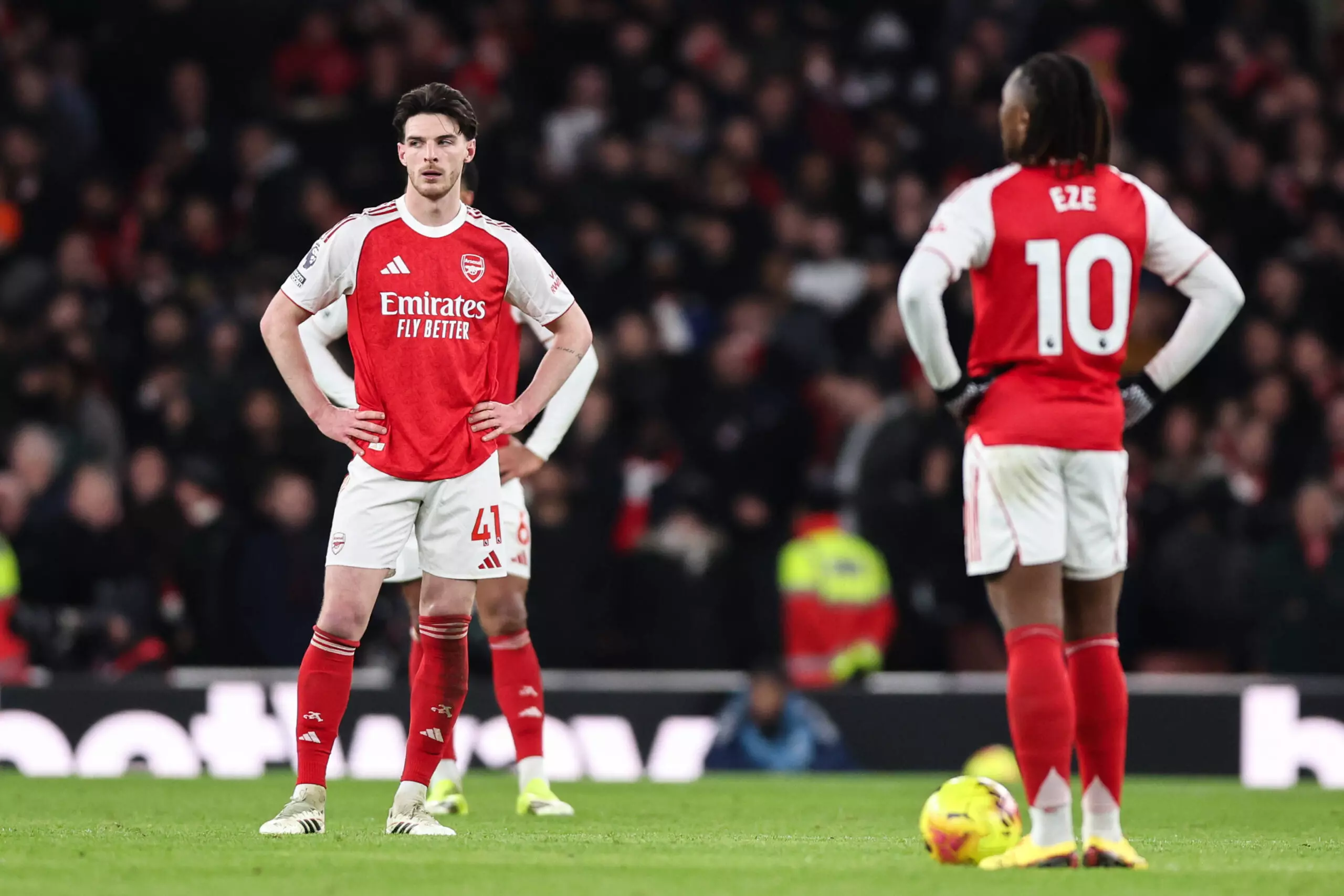
The proof was measurable. Arsenal have now made an error leading to an opposition goal in two of their last four league matches – already more than in their first 19 games of the campaign. Against United, that theme arrived in the most punishing form: a needless giveaway from Martín Zubimendi in his own third that handed Bryan Mbeumo a simple equaliser.
One mistake changed the stadium mood and, more importantly, Arsenal’s posture. Arsenal’s cautious approach was what dominated the rest of the contest, as it felt like a team trying to avoid the worst rather than force the best.
Arsenal’s Premier League Title Race Setback: The Switch From Authority to Anxiety
For the first 30 minutes, Arsenal played as if the Emirates belonged to them. They dominated territory, set the tempo, and pushed United into a deep, reactive shape. That pressure told when the lead arrived – Lisandro Martínez turning the ball into his own net in the 29th minute.
But the goal did not settle Arsenal; it exposed them. The equaliser that followed – Zubimendi’s error, Mbeumo’s finish in the 37th – flipped Arsenal into a cautious, protective mode. The change was visible: fewer brave passes, slower progression, and more security-first decisions once United had proof Arsenal could be forced into mistakes.
From there, the mentality gap became the match: United emboldened by opportunity, the Gunners guarding against another error, ultimately leading to Arsenal’s cautious approach replacing the authority they had shown early.
Control Without Bite vs Threat With Conviction
After the equaliser, the Arsenal vs Man United game stopped being about who had the ball and became about what each team tried to do with it.
Arsenal still had more of it – 56.1% possession – but their control rarely became open-play incision. Even after Mikel Arteta rolled the dice with changes, Arsenal managed only one shot between the hour mark and the 70th minute, a stretch where urgency should rise, not shrink.
The expected goals split underlined the issue. Arsenal finished on 1.19 xG, but only 0.42 came from open play; 0.78 came from set plays. Their most reliable route to danger wasn’t breaking United down enough – it was dead balls and second phases. In open play, the final actions were predictable and low-yield: 25 crosses, only four completed (16% accuracy). Pressure without clarity is noise, not threat.
United’s attacking footprint told the opposite story. They produced 0.71 xG overall – entirely from open play, with 0 from set plays. They did not need long spells. They needed moments, and they played for those moments.
How Arsenal Were Punished
Once Arsenal slipped into caution, United simplified the game to a single instruction: every possession had to travel toward the goal. No soothing phases. No overworking the final detail. They pressed for turnovers in risky zones, then attacked before Arsenal could reset, one-touch combinations, quick releases into space, runners committing defenders. The aim was to win the next 10 seconds.
That is how the defining goals arrived. Patrick Dorgu’s strike was the first punishment of mentality: he saw the opening and hit it, no hesitation. And when Arsenal clawed their way back late on, the real test arrived – protect the point or chase the win.
United chose the same answer they had chosen all night. Matheus Cunha stepped into space and curled a brilliant winner, the cleanest summary of the contrast: Arsenal trying to manage risk, United embracing it – an Arsenal loss at the Emirates shaped as much by mindset as by moments.
YOU MAY ALSO LIKE: Is The Fixture Congestion Crisis Breaking Modern Football?
(Photo by Harvey Murphy/News Images)
The Warning: Pressure Has Now Found Arsenal
Arsenal’s Premier League title race setback could be pinned on moments of individual brilliance from Manchester United, but the harder truth is that they started losing it the moment they focused on not losing it.
After going ahead, the priority shifted from imposing a second punch to avoiding a mistake. That change bled into everything – slower tempo, narrower risk appetite, and attacking choices designed to preserve control rather than force a win.
Now the context makes it heavier. Manchester City and Aston Villa are four points behind, and Arsenal will rue the missed chance to create breathing space after the Nottingham Forest draw. This is how Premier League title race pressure arrives: not with one catastrophic performance, but with a small retreat into safety that invites the opponent forward.
If Arsenal want this to be a warning rather than a pattern, the response has to be mental as much as tactical: braver decisions after scoring, quicker progression when momentum dips, and a willingness to keep attacking when nerves demand protection – because an Arsenal loss at the Emirates is never just a result, it is a signal.
Main Photo
Credit: IMAGO /Sportimage
Recording Date: 25.01.2026