
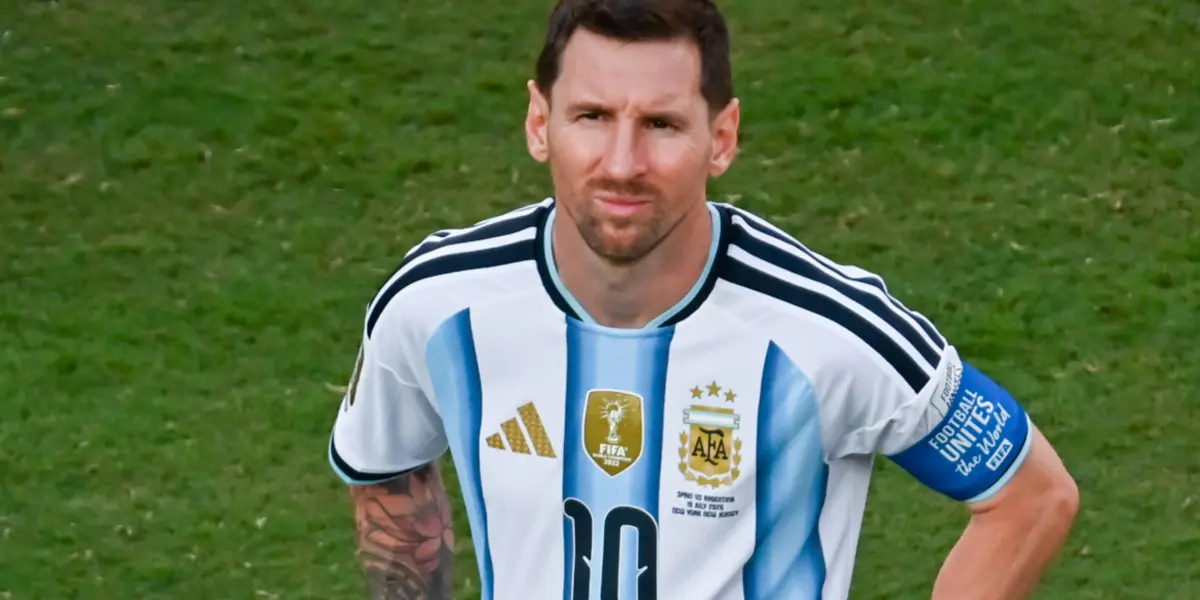
Lionel Messi retires from Argentina national team duty at 39, ending a 21-year international career that produced 207 appearances and 125 goals — the most in the country’s history. However, statistics cannot fully explain what Messi became to Argentina; his legacy was not created simply by winning the World Cup; it was created by surviving everything that came before it.
Lionel Messi Retires: Before The Glory, He Had To Endure The Criticism
When Messi first emerged for Argentina, the expectations were almost impossible. He had already become a phenomenon at Barcelona because he was producing moments that seemed to belong to another sport entirely. With Argentina, however, the comparisons were different: there was always Diego Maradona. There was always the question of whether Messi could reproduce his club brilliance on the international stage. There was always another final, another disappointment, another argument about whether the greatest player of his generation had done enough for his country.
That pressure became particularly cruel because Messi kept getting close; he reached the 2014 World Cup final, wherein Argentina lost to Germany. Then came Copa América final defeats in 2015 and 2016. For a player who had spent his career making the extraordinary look ordinary, those losses became evidence for his critics. So when people now search Messi retires, they should remember that his international story did not begin with celebrations; it began with an enormous burden.
Lionel Messi Retires: The Moment When He Almost Walked Away
The 2016 Copa América final defeat to Chile was devastating. Messi missed a penalty in the shootout, Argentina lost again, and the emotional weight became so great that he announced his retirement from international football.
For a brief moment, Argentina had to imagine a national team without its number 10, but then Messi came back. That decision would eventually change the entire story because the most important part of Messi’s Argentina career was not that he never failed; it was that he kept returning. That resilience is essential to understanding why Messi retires today as a figure whose international legacy extends far beyond his statistics.
Lionel Messi Retires: The Moment Everything Changed
The transformation began under Lionel Scaloni— Argentina stopped being a team built entirely around the expectation that Messi had to save everything.
A new generation arrived, the atmosphere changed, and the pressure became more collective. With this new mentality, Messi changed with it. In 2021, Argentina finally won a major senior international trophy, defeating Brazil in the Copa América final at the Maracanã. The image of Messi celebrating with the trophy was more than a sporting moment; it was epic. Years of criticism suddenly felt distant, and the player who had been accused of failing Argentina had finally delivered a major title.
For years, supporters had wondered whether Messi could finally end the cycle of disappointment. By the time Messi retires, that question has been replaced by something very different: how many memories did he create while wearing the Argentina shirt?
Lionel Messi Retires: The World Cup That Changed Everything
If the phrase Messi retires now carries a sense of finality, it is because Messi leaves international football having achieved the dream that once seemed impossible: the FIFA World Cup.
The 2022 World Cup transformed his relationship with Argentina forever: Messi scored, created, led, and endured throughout the tournament. In the final against France, he scored twice before Argentina eventually prevailed on penalties. When he lifted the World Cup trophy, the debate changed; Argentina no longer had to ask whether Messi could deliver on the international stage because he had done it. More importantly, he had done it after years of heartbreak.
That is what made the victory so powerful; had Messi won the World Cup at 24, the story would have been one of extraordinary talent fulfilling its potential. Winning it after the failures of 2014, 2015, and 2016 created something much more: redemption.
Lionel Messi Became Argentina’s Leader On The Pitch
There was another transformation happening alongside the trophies: Messi became emotionally connected to Argentina in a way that statistics could never measure. The shy, almost distant superstar who had sometimes been criticised for not being “Argentine enough” became the captain millions of Argentines looked toward in moments of joy and anxiety.
The criticism did not disappear overnight, but something fundamental had changed: Messi was no longer simply expected to win for Argentina; he was loved for everything he had already given it. The 2024 Copa América reinforced that bond, with Argentina lifting another major trophy under Messi’s leadership. By then, the old question – Why can’t Messi win with Argentina? – had become almost absurd because he had won again and again.
That is why the story behind Messi’s retirement is not simply about a player leaving the international stage; it is about how an entire nation gradually moved from demanding perfection from its number 10 to appreciating everything he represented.
YOU MAY ALSO LIKE: Gabriel Jesus To Barcelona: Is The Brazilian Striker The Answer To Barca’s Striking Problems?
Lionel Messi Retires: The Final Chapter Was Not Perfect
Football rarely gives its greatest stories the ending they deserve. Messi’s final international tournament ended with Argentina losing the 2026 World Cup final to Spain. There was no final World Cup trophy, no last-minute miracle, no Hollywood ending, and perhaps that makes his decision to retire from international football even more emotional.
He did not wait for another perfect ending because he accepted that his story with Argentina had already been written. Messi has explained that the decision was painful but that he believed the time had come, with younger players ready to take their opportunity. Reports also say he had reached the decision shortly after the World Cup final, with the death of his father, Jorge Messi, reinforcing his choice. That is not defeat; that is acceptance.
Lionel Messi Retires: The Numbers Tell Only Half The Story
Messi leaves Argentina as its most-capped player and its all-time leading scorer. 207 appearances, 125 goals, two Copa América titles, one Finalissima, and one World Cup.
Those numbers are extraordinary, but the most remarkable statistic might be simpler: he kept coming back. After losing finals, he returned. After being criticised, he returned. After announcing his first international retirement, he returned. After years of being compared with Maradona, he kept carrying the weight, and after finally winning everything Argentina wanted him to win, he still returned for more.
That is why the discussion surrounding Messi’s retirement should never be reduced to the date of his final appearance; it should be about the journey.
Lionel Messi Retires: The Maradona Comparisons
For much of his Argentina career, Messi was trapped inside a comparison: he was supposed to be the next Maradona.
Every touch was measured against 1986, every tournament was compared with Mexico, and every failure became another reason to argue that Messi could never truly occupy the same place in Argentine football history. Eventually, Messi escaped that comparison not by defeating Maradona or by replacing him, but by becoming Messi.
His Argentina story became its own story: different, longer, more complicated, and ultimately just as extraordinary. Maradona gave Argentina its unforgettable 1986 triumph; Messi gave it something else: a two-decade narrative filled with heartbreak, resilience, redemption and finally, glory.
Lionel Messi Retires: What He Leaves Behind
The greatest legacy of Messi’s international career may not be a goal, assist or trophy: it may be the way he changed what Argentina expected from its heroes. At the beginning, the demand was simple: win, but by the end, the feeling was different. That is the distance Messi travelled for his national team.
When fans search Messi retires, they may be looking for a news story or they may want to know when he announced it, why he made the decision or whether he will play for Argentina again but the deeper story is about something else, it is about a player who once appeared to be too foreign for his own country’s expectations to becoming one of the most beloved Argentines of his generation. It is about a superstar who was once blamed for Argentina’s failures and eventually became the captain who carried the World Cup glory. It is about understanding that Messi’s retirement does not mean Messi’s Argentina story has ended; instead, the story has already become history.
Messi’s Greatest Victory Was Not The World Cup
The World Cup was the greatest trophy, but it may not have been his greatest victory. His greatest victory was changing the relationship between a nation and a footballer who spent years trying to satisfy it. Messi did not win Argentina’s love simply because he won trophies; he won it because Argentines watched him suffer for the shirt. They watched him lose, they watched him cry, they watched him come back, and they watched him finally lift the trophies that had eluded him.
When Messi’s retirement became reality, the reaction was no longer dominated by questions about what he failed to achieve; instead, it was gratitude for everything he had given. That is the ultimate transformation; the boy from Rosario who once carried the impossible burden of becoming Argentina’s next Maradona leaves the national team as something more personal: Lionel Messi, Argentina’s great number 10, its captain, its record scorer, its most-capped player, and, for millions, its greatest footballing son.
So when we say Messi retires, perhaps the phrase should not sound like a question; it should sound like a farewell, as the criticism is over, the comparisons are over, and the chase is over. What remains is the legacy, and that legacy belongs not only to Messi, but to Argentina.
More Lionel Messi News
World Cup 2026 Final Spain vs Argentina: Three Key Factors, Predicted Lineups and Team News