
Manchester United have built their best football this season on one consistent pattern: everything good seems to flow from the right.
With Amad Diallo reinvented as a dynamic right wing-back and Bryan Mbeumo thriving in the right-sided No. 10 role, United’s most dangerous attacks have come through a channel that offers speed, clarity, and end-product. Their rotations, combinations, and understanding have given Ruben Amorim’s system a reliable heartbeat.
But that rhythm is about to be disrupted. With the AFCON call-ups confirmed for both players, Manchester United now face the reality of Amad Diallo and Bryan Mbeumo being called up by Ivory Coast and Cameroon, respectively. Their absence removes the two players who make the right flank click.
Should both countries reach the semi-finals, the pair could miss a challenging sequence of fixtures, including Aston Villa, Newcastle, Wolves, Leeds, Burnley, and Manchester City.
It’s a period that promises real difficulty, and it raises a pressing question: how efficiently can United operate without the players who have powered their most productive side of the pitch?
What United Lose – The Function of the Right Flank
Losing Amad Diallo and Bryan Mbeumo removes far more than individual quality. It strips away a structure that has shaped how United progress the ball, creates chances, and controls matches.
Amad has been the side’s most reliable carrier, offering composure when pressed and a natural ability to glide out of tight spaces. His movement opens passing lanes, his timing unsettles markers, and his willingness to play forward gives United a directness that no one else in the squad consistently provides from that side.
Just ahead of him, Mbeumo has been equally influential, which earned him a player of the month award. His positioning in the right half-space provides the link between midfield and attack, offering quick combinations, angled passes, and off-ball runs that stretch defensive lines.
Where Amad initiates momentum, Mbeumo turns it into a threat.
Together, they have built a rhythm opponents struggle to contain — a right-side engine that gives United width, penetration, and fluidity. Their rotations force defensive shifts, their understanding creates overloads, and their presence offers a sense of coherence that United often lack without them.
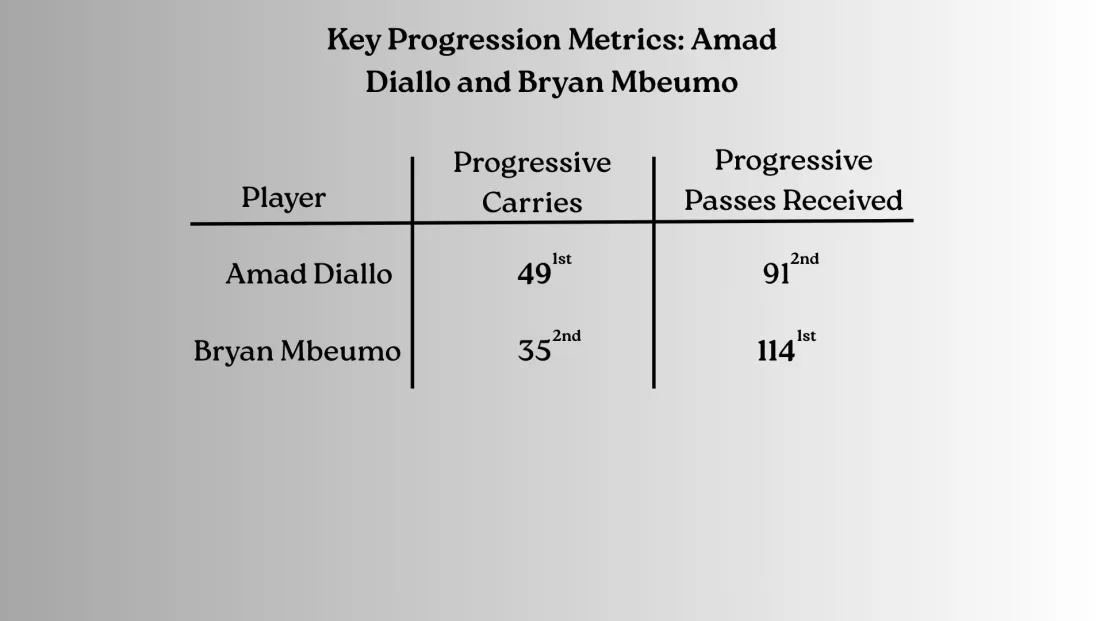
Their influence isn’t just visible on the pitch – the numbers back it up. According to FBREF, Amad Diallo and Bryan Mbeumo rank first and second for Manchester United in progressive carries this season, with 49 and 35, respectively.
Their impact also extends to how often teammates look for them: Mbeumo has received 114 progressive passes – the highest in the squad – while Amad is close behind with 91. These figures not only reveal their ability to drive play forward but also demonstrate the trust placed in them as United’s primary outlets for generating momentum.
Remove both at the same time, and United don’t just lose their best right-side players – they lose the balance, fluency, and confidence that the entire flank has provided all season. And with the AFCON call-up taking both of them out of the squad temporarily, United’s most dependable attacking pattern suddenly disappears.
How the System Changes With Them Off to AFCON
With Amad Diallo and Bryan Mbeumo called up, Ruben Amorim is pushed into a reshuffle that changes the entire feel of United’s attack.
The most likely adjustment is Diogo Dalot stepping in as the right wing-back. While Dalot offers energy and discipline, his profile leans more toward safe circulation than the progressive, off-the-shoulder carries Amad provides.
That instantly alters how United build from that side.
Further ahead, the absence of Mbeumo forces a reconfiguration of the two No. 10 roles. Mason Mount and Matheus Cunha are the natural options to occupy those positions, shifting United’s creative routes toward the centre rather than the right half-space. It means more combinations in congested areas, more reliance on tight pockets, and fewer natural outlets that stretch defensive lines.
For opponents who sit in a low block, this plays directly into their preference. United become easier to crowd, easier to trap, and easier to funnel into traffic. The unpredictability that the right side normally offers – with its rotations, angled runs, and constant movement – is replaced by a more static, centralised rhythm that compact teams are far more comfortable defending.
In effect, United lose the one route that consistently forces opponents to adjust. And when a team knows what’s coming, even if the players are capable, the attack naturally becomes less varied and less difficult to manage.
The Wider Impact and the Need for Others to Step Up
With the AFCON call-up stripping away the usual spark from the right flank, the responsibility shifts toward different areas of the pitch.
The two No. 10 roles in Ruben Amorim’s system – likely Mason Mount and Matheus Cunha, who returns from injury - become central to keeping United’s attack connected. Instead of the wide overloads Amad and Mbeumo often produced, United will rely more on combinations through the middle.
This might make the team a bit predictable, lacking that ever-efficient right-side route, but this is where sharper timing, quicker rotations, and more risk-taking in traffic, especially against compact defences, is going to be needed from the two No. 10s in Amorim’s system.
Dalot’s presence at right wing-back offers more discipline at the back, but he won’t replicate the same level of threat going forward. That means the creative burden naturally slides inward. Mount’s mobility, Cunha’s ball-carrying, and Zirkzee’s link play must collectively cover for what the right side typically supplies: quick triangles, disruptive movement, and the ability to unbalance defensive lines.
The right flank may not carry the same menace during the AFCON stretch, but this period gives the rest of the attack an opportunity to show they can shoulder responsibility. And how well they adapt will determine how smoothly they navigate this tricky run.
A Test of Adaptation, Not Survival
Amad Diallo and Bryan Mbeumo have become the heartbeat of United’s right-side creativity, but their AFCON call-up leaves a gap that cannot be ignored.
United must now find solutions to retain a creative outlet within the team – not as a luxury, but as a necessity. This period forces the squad to explore alternative routes of attack, compelling other players to step into roles they haven’t fully embraced.
If United manage to uncover an effective replacement pattern – whether through the dual No. 10 roles, a more fluid front line, or unexpected contributors – they won’t just survive this stretch; they’ll finish it with greater tactical flexibility.
And in hindsight, what appears to be a setback could become a silver lining: a test that ultimately broadens United’s attacking identity and prepares them for tougher phases ahead.
Main Photo
Credit: IMAGO / Visionhaus
Recording Date: 08.11.2025