

A New Era of Change for CONMEBOL
“It’s something unpredictable, but in the end it’s right…”
— Green Day, Good Riddance (Time of Your Life)
South American football is entering a new cycle, but its national teams are moving at different speeds. Argentina must replace Lionel Messi, Brazil must turn talent into direction, and Colombia must rebuild its creative core. Paraguay offer continuity, while younger squads elsewhere are searching for an identity. The September–October window revealed less about who won than about who has a plan for the next Copa America. Here’s your review of the international window.
Argentina Remain the Team to Beat
Argentina came into the window still carrying the weight of the defeat to Spain in the World Cup final, and the post-Messi era is already starting to take shape under Lionel Scaloni. A 4-0 win over Bolivia, a 7-0 demolition of Burkina Faso, and a 3-0 win over Benin in Messi’s farewell added up to 14 goals scored and none conceded, against three teams that missed the World Cup.
Read More: Argentina Says Goodbye to Lionel Messi With Tears and Fireworks
None of that erases the 1-0 World Cup final loss to Spain — Argentina games will still only matter against teams that can hope to compete with their global talent level. The real question is still whether anyone on the continent can knock them off the top at the next Copa America. What’s encouraging is who’s doing the scoring now. Nico Paz, Giuliano Simeone, Franco Mastantuono and Gianluca Prestianni all found the net during the window. Scaloni has finally been forced to hand over the keys to the next generation.
Brazil Have the Talent, Now What?
Brazil, still under Carlo Ancelotti, left the international window with two good results but not many real answers. A poor 1-1 draw with Australia was followed by a 4-2 win over the same opponent and a 4-0 win over India.
Rayan’s late equalizer against Australia in the first game was a feel good moment, and Ancelotti gave minutes to U-21 CBs Vitor Reis and Arthur Dias. Barcelona superstar Raphinha was pulled from the squad as a precaution after thigh edema. The bigger problem is the opposition — there’s only so much you learn from beating Australia and India, and it’s still too early to know what the next iteration of Brazil will be, contender or pretender.
Colombia Lack a Clear Gameplan
Néstor Lorenzo is trying to build a team without James Rodríguez and Juan Fernando Quintero at the center of it, and the results so far are mixed. A 1-1 draw with Mexico wasn’t convincing — Luis Suárez scored early, but Mexico finished the game stronger and Colombia were lucky not to lose it. A 1-0 loss to Paraguay followed before a 2-0 win over Peru in Miami turned things around.
Against Peru, the goals from newcomers Daniel Arcila (Leon) and Samuel Velasquez (Atletico Nacional) were real highlights. Gustavo Puerta impressed, Dávinson Sánchez looked steady in his first games as captain, and Daniel Muñoz kept providing the kind of energy that changes games. The question for Lorenzo is whether he’s rotating the squad enough — when results stop mattering as much, these windows are when you find out who’s actually going to be a key piece at the next Copa America. Camilo Duran (Celtic) needed more minutes.
Read More: USMNT’s Young Stars Shine as CONCACAF Sets Up Nations League Quarterfinals
Paraguay Are No Fluke
Gustavo Alfaro has given this team an identity, and the players clearly believe in it. That’s not nothing — the World Cup results, including the upset of Germany, were not a fluke. Wins over Bolivia and Colombia without conceding a goal, reinforced that impression.
Paraguay don’t have Argentina’s or Brazil’s talent level, and they’re not pretending to. What they have is a team that knows exactly what it’s good at and plays to it relentlessly. Alfaro has signed through 2030 and already said this will be his last coaching job. If that relationship keeps working the way it has, Paraguay should stay a genuinely difficult opponent through the next cycle.
Uruguay Get a Rude Awakening but Bounce Back
Diego Forlán’s first window as Uruguay manager started rough. Japan beat them 3-1, though Forlán’s team answered with a 4-1 win over South Korea and a 6-1 demolition of India.
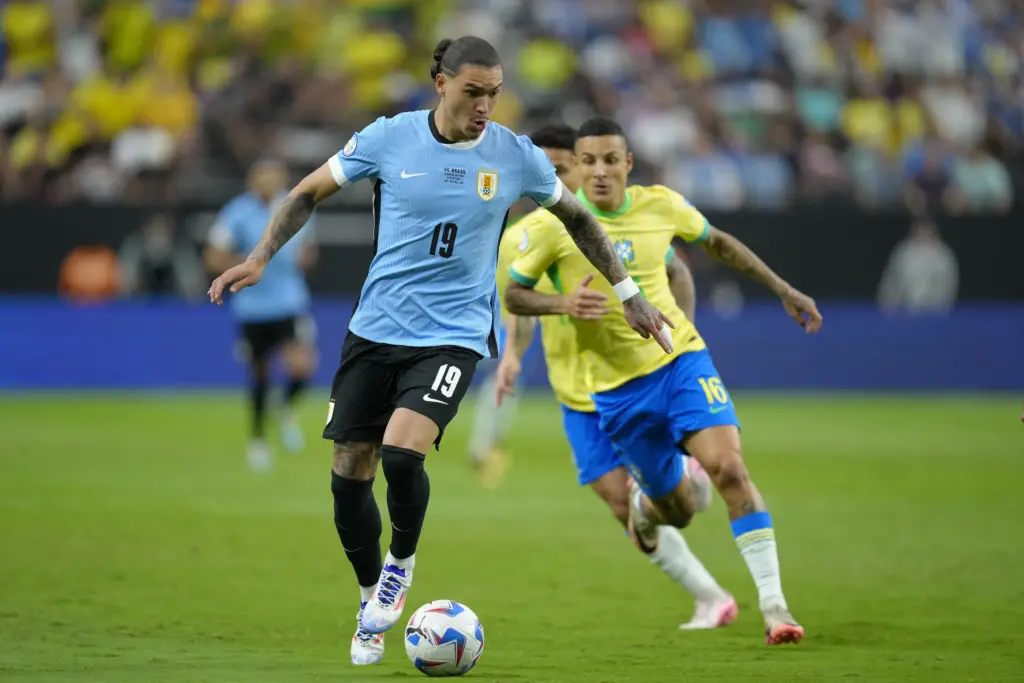
There’s no shame in that opening window, especially given how much Forlán inherited from the disaster of the Marcelo Bielsa era. Maximiliano Araújo continues to look like the squad’s most important attacking player — at 26 and entering his prime at Sporting CP, he’s turning into a genuine star rather than just a promising one after carrying his country in the World Cup. Darwin Núñez scored twice against South Korea and added another against India. If he and Araújo keep producing together, this attack has teeth again.
A notable negative: Giorgian De Arrascaeta’s wrist injury likely rules him out of Flamengo’s Libertadores semifinal, which hurts both club and country. Forlán should be able to patch some of what Bielsa left behind quickly. What Uruguay looks like after those fixes is the more interesting question.
Forlán’s quote to the press before the India match was a good one :“When you win, you’re not the best, and when you lose, you’re not the worst,”
Ecuador Still Can’t Score
Marcelo Gallardo has the keys to Ecuador now. La Tri is well-organized defensively and allergic to shooting. A 3-0 defeat against South Korea opened the window, followed by a scoreless draw with Japan, lost on penalties, and a 1-1 draw with Panama, also lost on penalties. Juan Riquelme Angulo scored Ecuador’s first goal under Gallardo in that Panama match, but the bigger issue is still finishing — Ecuador have scored three goals in seven matches going back to the World Cup opener against Ivory Coast, two of them in a must-win game against Germany. Against Japan, they managed five shots total.
Until that changes, nothing else about this team matters much.
Venezuela Finally Have Something to Build Around
Venezuela might be the most interesting team in South America heading into the next cycle. striker Kevin Kelsy, 22 and now at Rangers, scored in a 2-1 loss to Japan — another reminder of the talent coming through. Venezuela also drew South Korea on the road despite the travel, outshooting them 12-7, before closing the window with a scoreless draw against Jordan.
The age profile is encouraging. Venezuela started only one player against South Korea over 30, the goalkeeper; everyone else was 27 or younger. Only two starters were over 30 against Japan, with Luis Balbo of Sturm Graz and 18-year-old Marco Libra (Bologna) both getting real minutes. Venezuela could give some traditional powers headaches at the next Copa America.
Chile: Is There a Way Back?
Chile’s window was a mess, and then it wasn’t. Two red cards due to violent conduct helped sink them 1-0 to Canada. They then blew a 2-1 lead against the United States, getting overwhelmed 4-2 by a team that outran and outmuscled them at every turn. Then they beat Mexico 2-0.
Nicolás Córdova might actually have something here, even if Chile are nowhere near South America’s elite right now. Darío Osorio (Crystal Palace), Maximiliano Gutiérrez (Dynamo Moscow) and Vicente Pizarro (Rosario Central) are worth watching. The road back is long. But for the first time in a while, there’s a road.
Bolivia Still Need the Altitude
Bolivia are still dangerous at altitude and still ordinary everywhere else. That’s the whole story, and it’s been the whole story for most of their history. Until Bolivia can compete consistently away from home soil, it’s hard to see them escaping the same cycle — fearsome at home, forgettable on the road.
Peru Look Lost and Ancient
Another winless window for Peru, and the bigger issue isn’t the results — it’s that there’s no clear sense of where this program goes next. They’re still leaning on a veteran core, captain Yoshimar Yotún (Sporting Cristal), included, while the rest of the continent tries to get younger. Losing is one thing. Losing without giving the next generation a chance to learn, is a bigger problem. Against a young United States team, their average age was 31.1.
South America’s Post-Messi Power Rankings
1. Argentina
Still the standard. The next generation is already breaking through, and Scaloni has to put his trust in them now.
2. Brazil
Ancelotti has a talented squad, but the rebuild and reshaping continues.
3. Paraguay
No flash, no excuses — just a team that knows its limits and plays with consistent quality.
4. Colombia
Real questions at the center of the pitch, but enough depth in the talent pool to answer most of them and remain competitive.
5. Uruguay
When Núñez and Araújo are scoring, Uruguay feels dangerous again.
6. Ecuador
The defense is never the problem, but eventually they have to try playing a more attacking style.
7. Venezuela
A young, intriguing roster, can it come together in time for Copa America?
8. Chile
Still a long way from relevant, but Córdova’s young core gives them a direction after an awful 2026 World Cup qualifying campaign.
9. Bolivia
Impossible to beat at home in the thin air, unremarkable anywhere else — and that gap isn’t closing.
10. Peru
No results, and worse, no visible plan for the future.
Extra Time Notes
Argentina remain the team the rest of South America has to measure itself against, Brazil is still a talent factory, Colombia are starting a retooling period, Paraguay keep proving discipline travels further than talent alone, and Uruguay just handed the keys to a new manager with real attacking pieces already in place. Venezuela may finally be building their first World Cup team, Ecuador continue to look for goals like they are gold.
South American football is changing. This window was the clearest sign yet that the transition had to happen— and that some federations are further along than others.
More South American Football Coverage
Arturo Vidal’s Move to Center-Back Is Reviving Colo-Colo
In the Rain, San Lorenzo Reminded Us Why We Love Football
Main Photo Credit: Imagn Images via Reuters Connect