

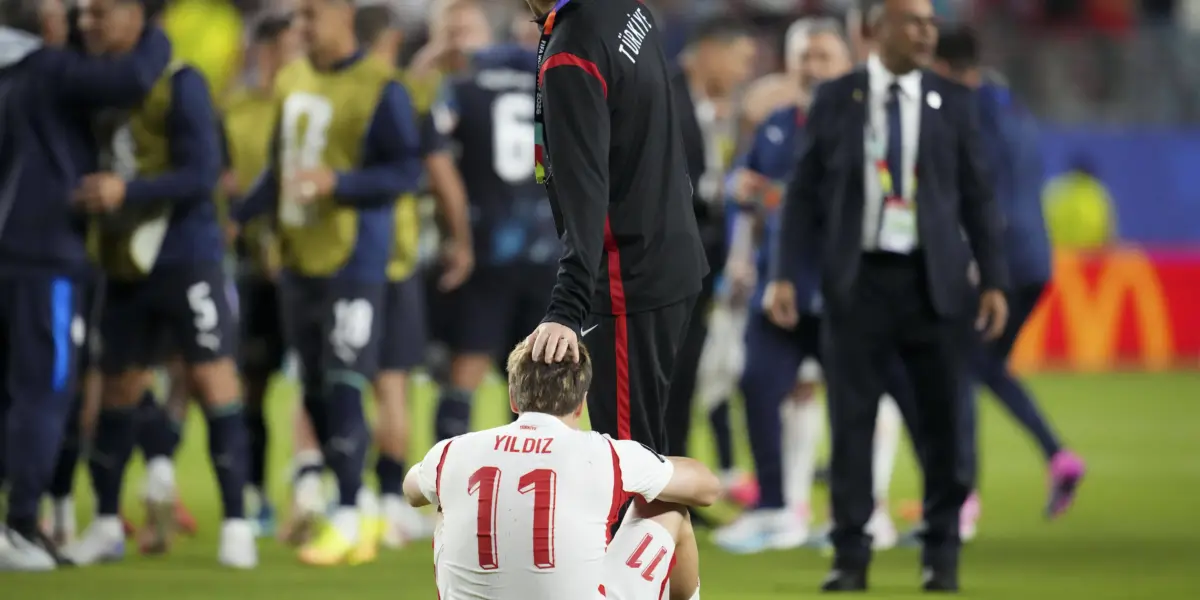
The disappointment of the Turkey 2026 World Cup exit was confirmed following a heartbreaking 1-0 defeat to Paraguay in their second Group D match.
After waiting 24 years to return to football’s biggest stage, expectations were high for a squad widely regarded as one of the most talented in recent Turkish history. Many even tipped them as the 2026 World Cup dark horses, believing they had the quality to make a deep run.
Instead, the tournament turned into a nightmare. Across their opening two matches, Turkey set an unwanted record for the most inefficient attacking display over two World Cup games since records began in 1966.
Vincenzo Montella’s side failed to score against both Australia and Paraguay, with their performance against the South Americans proving especially frustrating.
Despite Paraguay being reduced to 10 men before half-time, Turkey dominated possession with 78% of the ball and registered 50 touches inside the opposition’s penalty area, yet still could not find a way to end their goalscoring drought.
Turkey 2026 World Cup Exit: How The Lack Of A Clinical Striker Ended Their World Cup Dream
The ultimate path to victory in football is simple: score goals. Dominating possession for 90 minutes means little if it does not translate into finding the back of the net.
Turkey boast a world-class core featuring stars from Europe’s biggest clubs, including Inter Milan’s Hakan Çalhanoğlu, Real Madrid’s Arda Güler, and Juventus winger Kenan Yıldız.
While all three are capable of creating opportunities, the lack of a clinical, ruthless finisher proved to be one of the biggest reasons behind Turkey’s elimination from the World Cup.
The problem was perfectly illustrated against Paraguay. Turkey fired 32 shots and produced an expected goals (xG) tally of 3.6, yet failed to score. Even more remarkable, they squandered all five of the big chances they created.
Based on the quality of those opportunities, they should have comfortably scored at least three or four goals. Instead, they walked away empty-handed, with their wastefulness ultimately bringing Turkey’s World Cup journey to a disappointing end.
The most glaring example of Turkey’s profligacy came in the last five minutes of the game against Paraguay.
As the team increased the tempo in a desperate search for an equaliser, Barış Alper Yılmaz drove into the box before cutting the ball back for Can Uzun.
However, the 20-year-old Eintracht Frankfurt attacker could only produce a tame effort that was saved by the goalkeeper. The rebound then fell to Denis Gul, but the striker failed to compose himself, firing into the side netting.
Just before the final whistle, Guler delivered a pinpoint cross that found Gul in the box, yet his header drifted just wide of the left-hand post.
These missed chances perfectly showed why Turkey’s World Cup goal drought ultimately proved so costly, as wasteful finishing condemned the Turks to an early exit from the tournament.
Turkey 2026 World Cup Exit: Why Their 62 Shots Told A Misleading Story
Since Turkey’s exit from the World Cup, much of the discussion has focused on the fact that they registered 62 shots across just two matches.
While that figure might initially suggest relentless attacking intent, a closer look reveals why Turkey’s World Cup goal drought was driven more by poor decision-making than sheer bad luck.
Shot volume alone means very little when the quality of those efforts is consistently low. Half of Turkey’s 62 attempts came from outside the penalty area, highlighting their inability to break down well-organised defences and create clear-cut chances.
Instead of patiently working the ball into dangerous areas, they repeatedly settled for speculative long-range efforts with a far lower chance of finding the net.
Their shot accuracy was equally poor. Out of the 62, only 13 forced the goalkeeper into action, with the rest either flying off target or being blocked before reaching the goal.
Elite teams do not simply accumulate shots — they consistently create opportunities that force goalkeepers into difficult saves. That was something Turkey rarely managed, and it ultimately explains why their 2026 World Cup campaign ended with such a prolonged goal drought.
YOU MAY ALSO LIKE: Nottingham Forest Transfers: Midfield Reinforcements Needed As Elliot Anderson Continues To Spark Interest From Premier League Clubs

Turkey 2026 World Cup Exit: The Predictable Game Plan That Cost The Turks
Another major reason Turkey’s World Cup campaign ended in disappointment was Vincenzo Montella’s predictable attacking approach.
His insistence on slow, wing-oriented play gave opponents ample time to retreat into their defensive shape before Turkey could pose any real threat.
Key attacking players such as Yildiz were repeatedly forced towards the touchline instead of receiving the ball in dangerous central areas, where he could isolate defenders, combine with teammates, or drive directly at goal.
As a result, Turkey frequently resorted to lofting crosses into crowded penalty areas, making life relatively comfortable for opposition defenders.
Equally concerning was Montella’s reluctance to adapt. Following the opening defeat to Australia, many expected tactical adjustments for the must-win clash against Paraguay.
Instead, Turkey lined up with virtually the same blueprint, despite its shortcomings already being exposed.
There were too few quick one-two combinations through the middle, minimal off-the-ball movement to stretch defensive lines, and almost no positional rotations to create uncertainty among defenders.
Australia and Paraguay quickly noticed Turkey’s attacking patterns and defended accordingly. By staying compact, maintaining their shape, and denying space between the lines, they knew the Turks would eventually become frustrated and settle for speculative long-range efforts or hopeful crosses into the box.
The lack of tactical flexibility ultimately made Turkey’s World Cup campaign far easier to contain than many had anticipated.
Turkey vs USA: One Final Chance To End Their 2026 World Cup Goal Drought
Next up for Turkey is their third and final Group D fixture against one of the tournament hosts — the United States.
A match that, despite their elimination, offers Vincenzo Montella’s side one final opportunity to restore some pride, end their World Cup goal drought, and give their supporters something positive to take away from a disappointing campaign.