
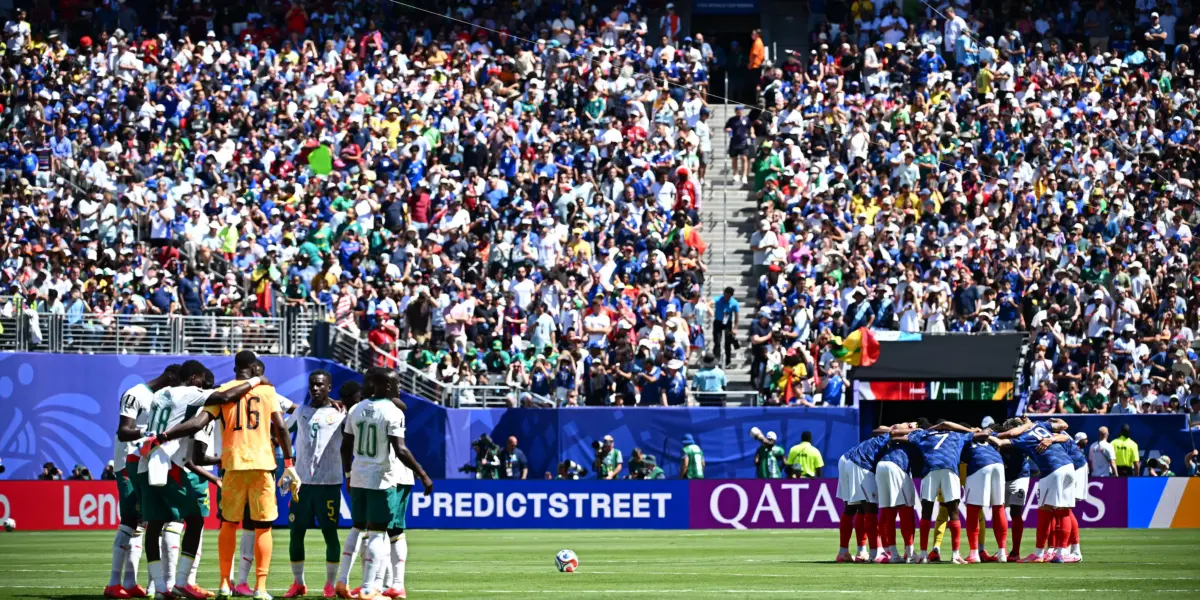
Heading into the sixth matchday of the 2026 World Cup, Senegal vs France was widely regarded as one of the standout fixtures of the group stage, with both nations having plenty at stake.
The 2025 AFCON finalists faced the 2022 World Cup runners-up, believing they had what it took to produce a statement result against one of the tournament’s favourites.
Meanwhile, France – boasting one of the most dangerous attacks in international football – was aiming to begin their campaign in dominant fashion as they set their sights on reaching a third consecutive World Cup final after their appearances in 2018 and 2022.
Although the final scoreline favoured Didier Deschamps’ side, the contest was far more competitive than it suggested, particularly in the first half, where Senegal’s hopes of pulling off a famous upset were ultimately undone by a series of costly mistakes that proved impossible to recover from.
The first and, until now, only previous meeting between the two nations came in the opening match of the 2002 FIFA World Cup at Seoul World Cup Stadium in South Korea.
France arrived as overwhelming favourites, having won the 1998 World Cup and the UEFA European Championship in 2000, while Senegal were making their debut on football’s biggest stage.
Against all expectations, the African side stunned the world with a memorable 1-0 victory. When comparing that historic Senegal vs France encounter 24 years later with the team that played on Tuesday, the contrast was striking.
In 2002, Senegal were ruthless when opportunities came their way and defended resolutely for the remainder of the match.
However, in 2026, the Lions of Teranga lacked that same clinical edge, squandering several promising chances to punish France before Didier Deschamps’ tactical adjustments at half-time allowed Les Bleus to seize complete control after the break.
Senegal vs France Analysis: First-Half Wastefulness That Changed the Course of the Game
As the first half of the encounter entered its closing stages, the Lions of Teranga squandered what would prove to be a defining opportunity.
Following a brilliantly worked team move, Sadio Mané delivered a pinpoint cross into the penalty area that found Crystal Palace winger Ismaïla Sarr in space.
However, the forward failed to bring the ball under control, sending his effort soaring over the crossbar from just eight yards out.
It was far from an isolated opportunity. Senegal had been the better side throughout the opening 45 minutes, creating several clear-cut chances, registering five shots to France’s one, and posting a higher expected goals (xG) tally of 0.28.
Chelsea striker Nicolas Jackson also came agonisingly close after being played clean through on goal. Racing towards the penalty area with only Dayot Upamecano to beat, he unleashed a powerful strike that cannoned off the left post before rebounding off French goalkeeper Mike Maignan and behind for a corner.
Those missed opportunities proved costly. Despite thoroughly outplaying Les Bleus in the first half, Senegal went into the dressing room with the score still locked at 0-0, denying themselves the psychological advantage their dominant display had deserved and ultimately setting the stage for France’s second-half resurgence.
Senegal vs France Analysis: Overreliance on Long Balls and Missed Transitional Opportunities
In the first half, France’s midfield looked unusually vulnerable, uncharacteristically slow in transition and often disjointed, creating a window of opportunity that Senegal failed to fully exploit.
It quickly became clear that Didier Deschamps’ side could be bypassed with quick, vertical passing and direct movements through the lines.
Senegal’s ideal approach should have been to draw the French midfield higher up the pitch, win possession in those areas, and then use sharp, short combinations to release technical creators such as Lamine Camara and Sadio Mané.
In the opening 10 minutes, Senegal briefly showed flashes of this blueprint, linking play effectively and creating early openings that unsettled the French defensive structure. That pattern did not last, however.
The double pivot of Pape Gueye and Idrissa Gueye lacked composure under pressure, and instead of trusting their ability to play through midfield, they repeatedly resorted to long, hopeful clearances.
These 40-yard balls were comfortably dealt with by William Saliba and Dayot Upamecano, both elite aerial defenders, allowing France to reset and regain control.
The constant surrender of possession blunted Senegal’s momentum, isolated Nicolas Jackson up front, and limited Sadio Mané’s influence in transition.
As a result, the Lions of Teranga were never able to build sustained pressure, despite the early signs that France’s structure could have been meaningfully exposed.
YOU MAY ALSO LIKE: Ruben Amorim to AC Milan: Can the Portuguese Coach Restore the Rossoneri to Domestic and European Glory?
Senegal vs France: Deschamps’ Tactical Masterclass Seals Second-Half Dominance
After Senegal failed to convert their first-half chances, the French national team regrouped after the break, and Didier Deschamps’ tactical adjustments proved decisive in sealing a 3-1 victory.
The introduction of greater fluidity in midfield, particularly by shifting Michael Olise into a central role, proved fatal for Senegal, as the Bayern Munich winger began to orchestrate attacks that ultimately allowed Kylian Mbappé to continue breaking FIFA World Cup records.
With pressure steadily mounting on the Senegalese backline, their defensive structure eventually collapsed in the second half as France’s superior quality became increasingly difficult to contain.
Deschamps’ substitution, bringing on Bradley Barcola, also had an immediate impact, with the PSG winger making an instant contribution by scoring a well-taken goal to extend France’s lead to two.
Next up, Senegal will face Erling Haaland’s Norway in their second group game, while France turn their attention to Iraq in the next phase of fixtures.