
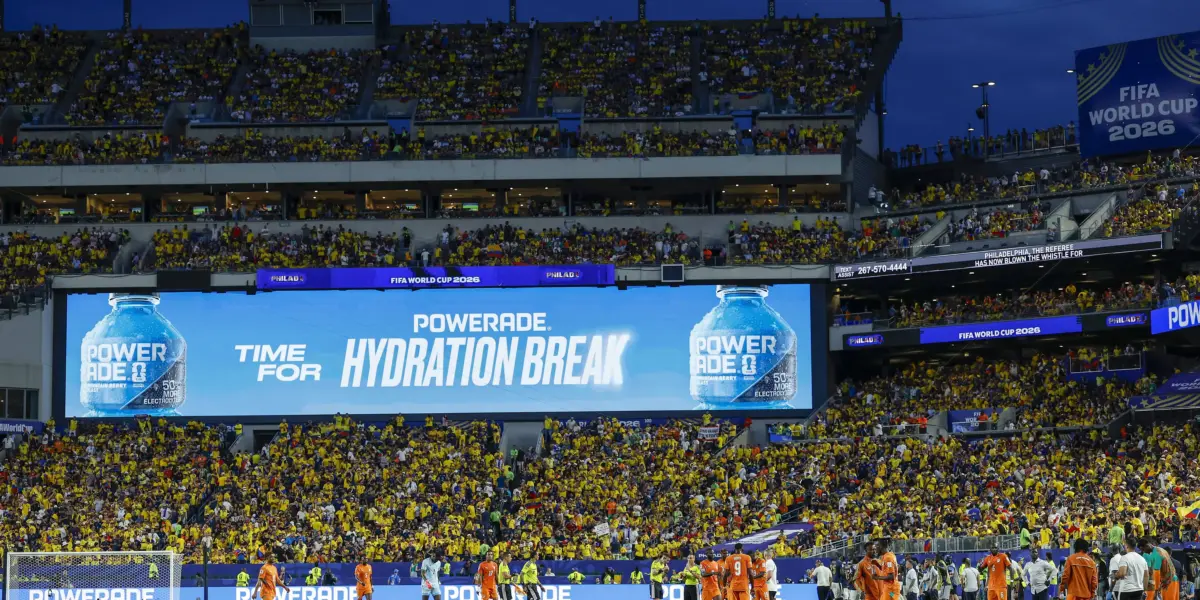
The World Cup hydration break introduced by FIFA ahead of the tournament has come under increasing scrutiny, with both fans and players questioning its impact on matches.
Several new rules have been implemented at the 2026 World Cup, and many have been widely praised for improving the flow of games.
From the substitution rule that gives players just 10 seconds to leave the pitch via the nearest boundary line, to the five-second countdown on throw-ins and goal-kicks, FIFA’s latest changes in the World Cup have largely been viewed as positive additions.
The throw-in rule, which awards possession to the opposition if a restart takes longer than five seconds, and the goal-kick regulation that results in a corner kick being awarded if the goalkeeper delays for too long, have significantly reduced time-wasting and helped maintain the tempo of matches.
As a result, these measures have been welcomed by supporters who have enjoyed a faster and more fluid style of football.
However, the same cannot be said for the hydration break. FIFA announced a mandatory three-minute hydration break that has been implemented across all 15 World Cup matches played so far.
Unlike the other rule changes, the reaction to this particular innovation has been overwhelmingly negative.
Many fans believe the stoppage disrupts the flow of matches — the very issue FIFA’s other rule changes were designed to eliminate — especially when games are reaching their most exciting phases.
Players have also voiced concerns, arguing that the breaks can drain the intensity, momentum, and emotional edge from contests at crucial moments.
The criticism has gone beyond footballing reasons. Some supporters have questioned FIFA’s motives for introducing the breaks, suggesting that the stoppages are designed more for commercial purposes than player welfare.
Critics argue that the additional pause creates more opportunities for television advertisements and sponsorship activations, while doing little to improve the actual spectacle on the pitch.
With debate continuing to intensify as the tournament progresses, the World Cup hydration break is rapidly becoming one of the most controversial talking points of the event.
World Cup Hydration Break: How FIFA’s New Rule Is Disrupting Football’s Natural Flow
What makes the rule even more frustrating for many viewers is that it is mandatory in every match, regardless of the conditions, in the name of maintaining uniformity across the tournament.
Critics have noted that even games played in temperature-controlled indoor stadiums or during cooler evening conditions are still paused around the 22nd and 67th minutes of each half.
As a result, some fans argue that the measure has altered football’s traditional structure.
With two scheduled stoppages effectively dividing each half into separate segments, critics claim the sport has moved closer to an American-style quarter system, something many supporters feel goes against the game’s long-established rhythm and flow.
World Cup Hydration Break: How FIFA Accidentally Created Football’s Unofficial Tactical Timeout
The hydration break has also exposed what many see as a major contradiction in football’s rulebook. Ahead of the tournament, the International Football Association Board (IFAB) prohibited tactical timeouts in an effort to preserve the traditional flow and integrity of the game.
Yet, by introducing a mandatory three-minute stoppage, FIFA may have unintentionally created the perfect substitute.
Rather than simply rehydrating, players routinely gather around their coaching staff during these breaks, giving managers a valuable opportunity to deliver tactical instructions, tweak formations, address problems, and halt an opponent’s momentum.
In effect, critics argue that the hydration break functions as an unofficial tactical timeout, achieving many of the same objectives that football’s lawmakers sought to prevent in the first place.
YOU MAY ALSO LIKE: Marc Cucurella’s Transfer To Real Madrid: Why Chelsea Are In A Good Position Even With The Departure Of Their Star Full-Back
World Cup Hydration Break: Liverpool Star Virgil van Dijk Criticises Mandatory Stoppages
Following the Netherlands’ entertaining 2-2 draw with Japan, Dutch captain and Liverpool defender Virgil van Dijk voiced his concerns about the mandatory hydration breaks during his post-match press conference.
The veteran centre-back questioned the necessity of enforcing the stoppages in every game and highlighted how the frequent cutaways to television commercials during the breaks detract from the viewing experience for supporters.
He said: “I think hydration breaks are really interesting. I was obviously watching almost all of the games up until today. I think every time going to commercials is a bit, not really something that I like.”
“I think for the neutral watchers on TV, it is also not great. So if it is really hot, it would be good to put them in, but I think you have to look at it in every game separately, in my opinion. But I think I have said enough already on that.”
Despite the good intentions behind FIFA’s mandatory hydration break, the rule has quickly become one of the most divisive innovations of the 2026 World Cup.
It remains unclear whether it will be adopted in other competitions, but given the mixed reception it has received during the tournament, there are growing doubts about whether fans, players, or pundits would embrace its introduction in future editions.