
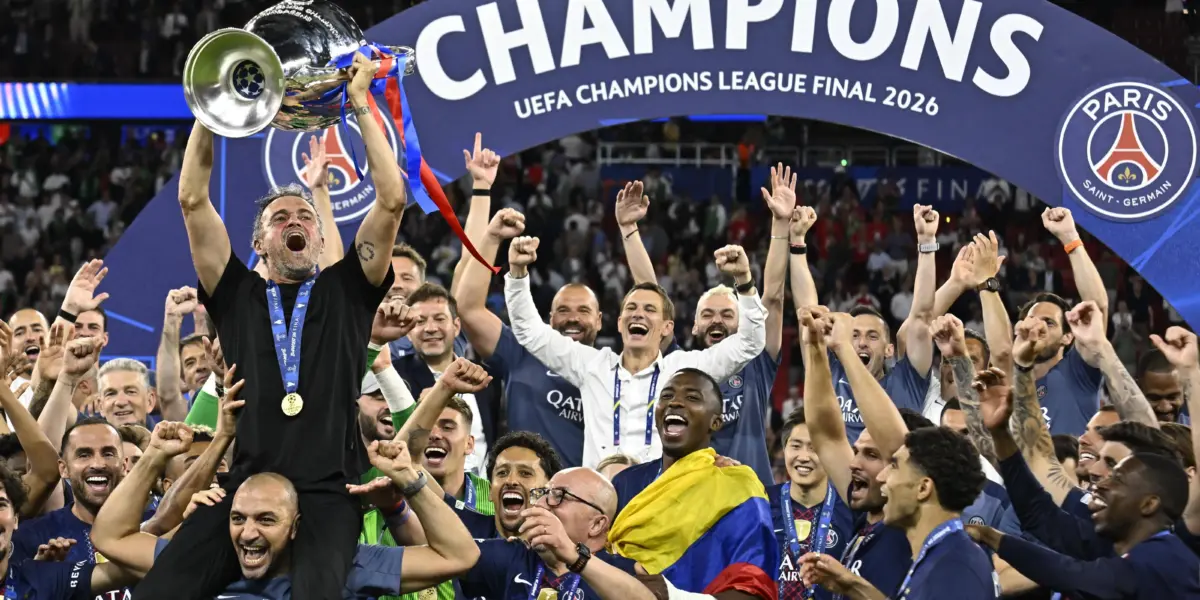
The Luis Enrique Champions League success with Paris Saint-Germain has been a remarkable achievement, as the Spanish manager has turned PSG into one of the most feared teams in Europe.
Luis Enrique handed Paris Saint-Germain another UEFA Champions League victory after defeating Arsenal on penalties in the final in Budapest, marking their second consecutive title triumph.
Paris Saint-Germain are now flying high on the global stage and have become nearly impossible to contain for other European teams, largely due to the Luis Enrique influence.
The story behind the PSG Champions League success stretches far beyond the players on the pitch, with Luis Enrique’s vision and leadership proving instrumental to the club’s dominance
Luis Enrique Champions League: The Numbers And History Behind PSG’s European Dominance
The Luis Enrique influence has been the driving factor behind the PSG Champions League success, as he has completely transformed the trajectory of the club.
Before his arrival, PSG had only reached one Champions League final, where they were defeated by Bayern Munich in 2020.
Despite the club’s massive investment in signing star players like Neymar, Lionel Messi, and Kylian Mbappe without any European success to show for it, Enrique was brought in to turn the tide around.
His arrival in 2023 marked a shift from superstar reliance to a collective, high-pressing and fluid system. He reached the semi-finals in his first season, which proved to be the first step towards success.
That progress became evident in the 2024/25 season as Paris Saint-Germain cruised to their first-ever Champions League title after defeating Inter Milan in a stunning 5-0 victory, breaking the record for the largest winning margin in a final in decades.
Following that historic triumph, questions quickly emerged about PSG’s consistency and whether they could retain the title the following season.
However, they answered those doubts in the 2025/26 campaign by defeating another Premier League side, Arsenal, on penalties after a 1-1 draw, with Khvicha Kvaratskhelia winning the Player of the Season award for his brilliant performances. The victory made PSG the first team since Real Madrid to win consecutive Champions League titles.
That win also made Enrique only the second manager, after Zinedine Zidane in the modern era, to win back-to-back UEFA Champions League titles, while also becoming the first Spanish coach to achieve the feat consecutively since the 1950s.
Building A Winning Culture: How Enrique Changed PSG’s Mentality
The Luis Enrique Champions League success with Paris Saint-Germain is deeply rooted in his influence and the way he changed the club’s culture.
His arrival transformed the club’s philosophy from heavy reliance on star players, which often created individualism and ego clashes, into a team focused on collective effort with no privileges or hierarchies.
He built a family-like atmosphere on and off the pitch, with players regularly speaking about the unity, trust, and belief in his approach.
In addition to that, he demanded total commitment from all players in pressing, defensive duties, and positional discipline, regardless of their name or status.
He also focused heavily on squad rebuilding, youth development, and integration. Four players under the age of 25 started the 2026 Champions League final, a testament to how he has blended experience and youthfulness together within the team.
Beyond the tactical side of the game, Enrique instilled a winning mentality into the squad, helping the players remain resilient during difficult moments. Many players, after the 2026 final triumph, were already talking about the possibility of winning a third consecutive UEFA Champions League title.
The Luis Enrique influence on this PSG team has changed the mentality and culture of the club and turned them into one of the most dangerous teams in Europe.
The Tactical Blueprint: How Luis Enrique Continues To Outmanoeuvre Europe’s Best
While mentality has been a major factor behind their success, the PSG Champions League success cannot be analysed without looking at the tactical blueprint under Luis Enrique.
The Luis Enrique tactics start with a base 4-3-3 formation, which often builds into a 3-2-5 or 3-3-4 shape in possession with overlapping full-backs, advanced midfielders, and a fluid front three.
Out of possession, he focuses on a compact 4-3-3 press that forces play wide before immediately recovering possession from opponents.
His tactical innovations include an out-ball or long-kick restart tactic where the goalkeeper deliberately kicks the ball out of play to trigger an organised press that disrupts opponents’ build-up transitions.
The Luis Enrique tactics place strong emphasis on positional discipline, giving players freedom while maintaining a structured system.
One of the key elements of his approach is total midfield control, with his midfield trio dictating the tempo of games and linking defence to attack effectively.
In attack, he focuses on fluidity, with wingers drifting inside and constantly switching positions to create unpredictability for defenders.
This philosophy allows PSG to beat possession-based teams in Europe through superior structure and transitions, while also countering high-pressing sides with technical quality and quick escapes.
As a result, opponents often struggle to deal with PSG’s movement, positional rotations, and lack of a fixed focal point upfront. The unpredictability leaves teams chasing shadows while the French side continues to dominate games.
YOU MAY ALSO LIKE: Andoni Iraola Managerial Career: Ex-AFC Bournemouth Manager Chased Down By A Number Of Top Clubs
Beyond The Stars: How Enrique Built A More Complete PSG Team
The effectiveness of Enrique’s tactics is closely linked to the collective responsibility he has built throughout the squad.
The PSG European success is a testament to that collective approach, with Luis Enrique’s influence playing a pivotal role.
Despite having stars within the squad, Enrique has focused on a multi-functional system where the structure is more important than any individual player.
He has instilled a philosophy where nobody is bigger than the team, with every player expected to press, defend, and maintain positional discipline while contributing to the overall intensity of the side.
This has increased individual responsibility and involvement throughout the squad and has allowed Enrique to win several matches without key players being available.
He has also built stronger squad harmony, a significant improvement from the Messi and Mbappe era, as collective responsibility now makes the team far more balanced and difficult to stop in Europe.
Another important factor has been squad depth and rotation. With every player fully buying into the system, rotations in Ligue 1 have become possible while still maintaining high standards.
This has helped keep key players fresh for Champions League matches and has played a major role in PSG’s treble and back-to-back Champions League triumphs while also helping the club manage injuries effectively.
Is Luis Enrique Defining A New Era Of Champions League Success?
The Luis Enrique Champions League triumphs with Paris Saint-Germain have ushered in a new era in European football.
For many years, it seemed unlikely that another club would replicate Real Madrid’s achievement of winning consecutive Champions League titles. However, Enrique has now matched that feat with Paris Saint-Germain and firmly established them among Europe’s elite.
This achievement has further elevated Enrique’s reputation and strengthened his position among the most successful managers in modern football.
If PSG continues on this path, the Luis Enrique Champions League success may be remembered as the foundation of a new era of dominance in European football.
Main Photo
Credit: IMAGO / PRESSE SPORTS