
There was a time when the Premier League games’ biggest compliment was simple: control.
Keep the ball, dictate the tempo, pin the opponent back, suffocate transitions, create numerical advantages, and repeat until the opening appears. But there was always another kind of chaos; Sergio Agüero’s 93:20 against QPR in 2012, Wayne Rooney’s outrageous bicycle kick against Manchester City in 2011, or Darwin Núñez’s 98:37 winner for Liverpool against Nottingham Forest in 2024 – moments that arrived after long stretches of controlled, tactical football.
Now, something feels different in Premier League games: the chaos is arriving much earlier. You no longer have to wait until the 89th minute for a match to lose its shape because, increasingly, it starts from the first whistle. Teams press high, defensive lines push forward, midfielders sprint into the box, full-backs overlap, and transitions arrive before spectators have even settled into their seats.
The early weeks of the 2026/27 Premier League games have produced a faster, more transitional, and increasingly unpredictable spectacle, with goals up to 2.82 per game from 2.75 last season and fast-break shots rising from 1.75 to 2.08 per match. The early weeks of the 2026/27 season have produced a different kind of spectacle.
Premier League Games: Control Is Becoming Harder To Find
Modern football has spent years obsessing over control.
Pep Guardiola’s Manchester City became the ultimate expression of it: dominate possession, establish territory, and counter-press immediately after losing the ball and force opponents to defend for long periods. But football evolves because opponents evolve.
The modern pressing team does not necessarily want to sit in a compact mid-block and wait. Hence, it wants to attack the opponent’s build-up immediately. Centre-backs are pressed, full-backs are jumped on, passing lanes are closed, and the goalkeeper becomes an active participant in the first phase.
One bad pass can transform a patient possession sequence into a three-on-three sprint. That is one reason Premier League games are increasingly resembling transition contests. The more aggressively teams press, the more space they leave behind the first defensive line. Beat the press, and suddenly there is opening everywhere.
The Counter-Attack Is Back In Fashion
For years, possession football dominated the conversation. Now, directness is enjoying a revival in Premier League games.
Recent analysis has pointed to a decline in possession dominance and an increased emphasis on physicality, running power, and direct play. That does not mean teams have abandoned sophisticated positional play, far from it. Instead, elite coaches are increasingly interested in what happens after the structure breaks.
Imagine a team building patiently from the goalkeeper; the opposition presses high, the ball reaches the No.6, one touch takes a midfielder beyond the first wave, suddenly, the winger accelerates into the channel.
That moment is football’s jackpot. The transition has begun.
The winger drives inside, the striker attacks the near post, the opposite winger makes a blindside run, the full-back overlaps, and the defensive midfielder races 40 yards to support. Five seconds later, the tactical diagram has disappeared.
That is why Premier League games can change so violently from one phase to another.
ALSO ON ETT: Raphinha Form: How Barcelona’s New Number Nine Role Has Unleashed A Goal Machine
Manchester City Just Gave Us The Perfect Example
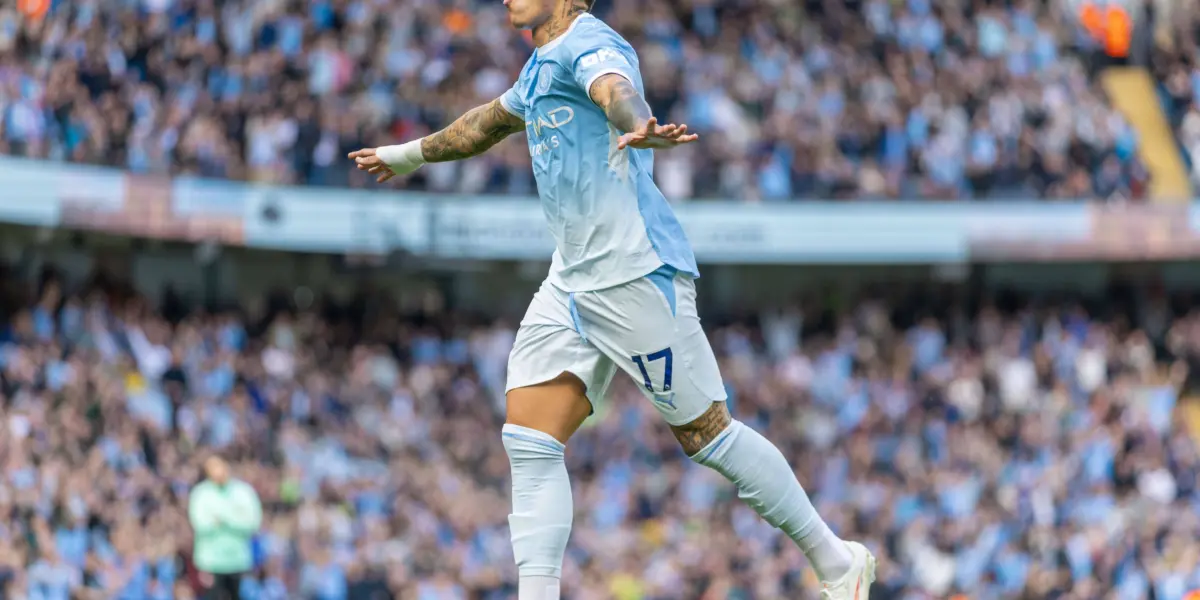
The 5-3 victory over Sunderland was almost a caricature of this new footballing reality: City led 1-0, 2-1, and 3-2 during the first half. Sunderland refused to retreat, while Brian Brobbey repeatedly attacked the space behind City’s defence and completed his hat-trick.
Sunderland registered nine shots on target while City repeatedly found themselves defending situations that would once have been considered uncomfortable for a possession-heavy side. This was not necessarily bad defending in the traditional sense, it was the consequence of playing on the edge.
City wanted attacking numbers while Sunderland wanted to press aggressively. Both teams wanted verticality. The match became a chain reaction; One attack created another, one turnover created another transition, every goal changed the emotional temperature of the game, and suddenly Premier League games feel impossible to script.
The Midfield Is Becoming A Battlefield
Perhaps the biggest change is happening in midfield. The classic possession structure often relied on a stable triangle: centre-backs behind, a controlling No.6 in front, and interiors operating between the lines.
But modern pressing disrupts that geometry. Midfielders now have to do everything; they must receive under pressure, turn, cover enormous distances, counter-press, break lines, and sprint into the box.
The old distinction between creator, destroyer, and runner is becoming increasingly blurred. The attacking midfielder is often behaving like a second striker, the full-back may become a midfielder, the winger may become the first defender, and the striker may initiate the press rather than simply finish it.
When everybody is moving, Premier League games naturally become more volatile.
More Shots From Distance, More Uncertainty
Another fascinating feature of the current season is the rise of shooting from outside the penalty area.
At the same time, close-range and set-piece goals have declined. That matters because long-range shooting introduces an element of chaos (Just watch Dominik Szoboszlai’s rocket goal vs in-form Tottenham.)
A low-probability shot can take a deflection, a goalkeeper can be unsighted, a loose second ball can fall perfectly, and a midfielder can suddenly produce a 25-yard thunderbolt.
It does not replace high-quality chance creation, but it adds another weapon to the attacking toolbox, and when teams are already playing at high speed, those moments become particularly dangerous.
The Psychological Effect Is Enormous
There is another reason these matches feel so chaotic: nobody seems safe.
A two-goal lead no longer automatically produces a calming effect. The trailing team can press higher while the leading team can attack the space left behind. One goal changes the momentum, suddenly the crowd wakes up, defenders retreat five yards, and the entire game tilts. That psychological volatility is part of the entertainment.
Look at City against Sunderland, at 4-3, Sunderland were within one goal of an astonishing comeback. Rúben Dias had to make a crucial goal-line clearance before Erling Haaland eventually settled the contest. Eight goals later, the match felt less like a conventional league fixture and more like a cup tie in extra time. That is the attraction.
YOU MAY ALSO LIKE: Poland UEFA Nations League Squad 2026: A New Beginning For The Poland National Team

Chaos Does Not Mean Bad Football
This is perhaps the most important distinction: Chaos is not the same as tactical incompetence. A match can be tactically sophisticated while appearing completely wild.
The press can be meticulously choreographed, the counter-press can be rehearsed, the rotations can be deliberate. The attacking patterns can be automated, but once two ambitious teams meet, those systems collide. The result is uncertainty, and uncertainty is exactly what Premier League games need.
The best Premier League games do not merely demonstrate tactical superiority. They create the possibility that something unexpected could happen at any moment. That is what makes this version of the league so compelling.
The Premier League may not have abandoned control because it may simply have discovered that control is temporary. A team controls possession for 20 seconds, loses the ball, survives a counterattack, wins it back, launches another attack, and concedes from a long-range shot. Then the opponent does exactly the same thing.
The tactical battle becomes a race between structure and disorder. And right now, disorder is winning plenty of rounds. If the trend continues, Premier League games may be heading toward one of the most entertaining scoring seasons in recent memory.
The current 2.82 goals-per-game rate is already above last season’s figure, although the sample remains early and could change significantly as the campaign develops.
For supporters, that uncertainty is intoxicating. For defenders, it must be exhausting. For managers, it may be terrifying. For everyone else, it is wonderfully chaotic. And perhaps that is the new Premier League: less control, more transition, more risk, and absolutely no guarantee of what happens next.
Extra Time Notes
Premier League games are entering an era where control is no longer guaranteed as relentless pressing, aggressive transitions, and fearless attacking football are turning matches into high-speed battles from the opening whistle.
Goals, counterattacks, long-range strikes, and rapid momentum swings are making games increasingly unpredictable, with Manchester City’s chaotic 5-3 win over Sunderland serving as the perfect snapshot of this new reality of Premier League games.
But beneath the madness is sophisticated modern football: carefully rehearsed pressing traps, positional rotations, and counter-pressing systems designed to exploit the instant structure breaks down. The result is a league where one pass can ignite a counterattack, one turnover can change the entire match, and even a two-goal lead can feel dangerously fragile.
Control may still be the objective, but in today’s Premier League games, chaos is becoming the price of trying to achieve it.
More Premier League News:
Manchester United’s Fitness Woes: Should Poor Running Stats Ring Alarm Bells?
Chelsea Formation: Should Xabi Alonso Switch to a Back Four After the International Break?