

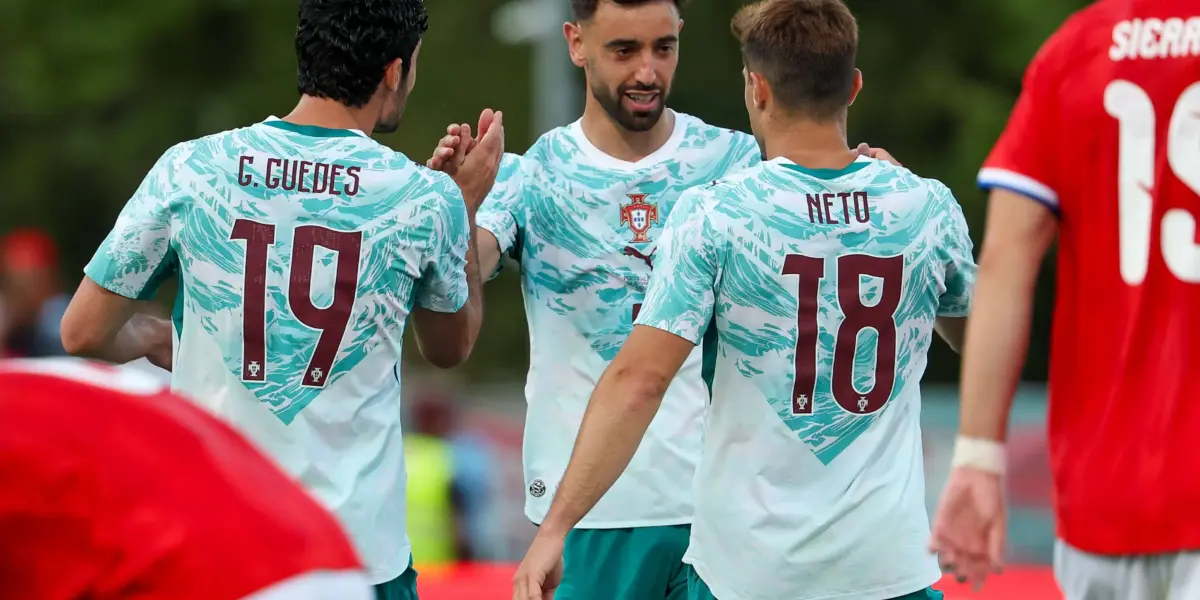
Portugal’s 2026 World Cup chances are once again a major talking point, with opinions divided over whether a talented generation led by Cristiano Ronaldo can finally guide the nation to its first-ever FIFA World Cup triumph.
With just five days remaining until the start of the World Cup, several nations enter the tournament as favourites, and Portugal are firmly among them.
Having won the 2025 Nations League title against Spain, Roberto Martínez’s men are no longer viewed as dark horses.
With a squad full of players operating at the peak of their powers and impressing consistently at their respective clubs, Portugal have been firmly established as one of the leading contenders heading into the tournament.
The Portuguese squad is packed with quality in every department, from a defence anchored by experienced and battle-tested Premier League champions João Cancelo, Rúben Dias, and Nuno Mendes, to a midfield orchestrated by the influential Bernardo Silva and Bruno Fernandes.
Fernandes, in particular, has enjoyed the form of his life, winning the EPL Player of the Season award and emerging as the leading contender for the PFA Player of the Year after producing a historic campaign in which he broke the 23-year-old record for most assists in the EPL season.
Further strengthening Portugal’s credentials is the dynamic PSG duo of Vitinha and João Neves, both of whom arrive at the World Cup fresh from securing back-to-back Champions League titles with Paris Saint-Germain.
Meanwhile, Portugal’s attack is equally stacked with talent. Chelsea winger Pedro Neto, along with João Félix and Rafael Leão, provide pace, creativity, and flair in the final third, while five-time Ballon d’Or winner Cristiano Ronaldo continues to spearhead the frontline.
With such an abundance of quality across the squad, it is easy to understand why many believe Portugal possesses all the tools needed to mount a serious challenge for their first-ever World Cup crown.
However, some still doubt whether Portugal are capable of achieving their ultimate goal, as they believe that the very player who has long been their greatest fear factor could now be the reason for their downfall.
Portugal’s 2026 World Cup Chances: Are Roberto Martinez’s Men Better Without Cristiano Ronaldo?
The team’s recent friendly offered another example of why some supporters believe Cristiano Ronaldo’s continued presence could ultimately affect Portugal’s 2026 World Cup hopes.
During the Portugal vs Chile match on Saturday, there appeared to be a noticeable shift in the team’s attacking rhythm after the veteran forward was withdrawn.
In the first half, with Ronaldo leading the line, Portugal’s attack often looked sluggish and disconnected. The Al-Nassr striker frequently held onto possession for too long in dangerous areas, slowing down transitions and overlooking promising runs from teammates such as Rafael Leão and Francisco Conceição.
In the second half, the contrast in the team’s fortune became evident after his substitution.
Just 12 minutes in, replacement Gonçalo Guedes opened the scoring, and Portugal immediately looked more fluid and unpredictable in the final third while also generating a higher xG than in the first half.
The movement across the frontline improved, combinations became quicker, and the attack appeared less reliant on a single focal point.
There have been several occasions in recent years where Portugal have appeared more difficult to defend against without Ronaldo on the pitch.
While his experience and goalscoring reputation remain invaluable, critics argue that Portugal’s attacking structure can sometimes become too focused on finding their talisman rather than exploiting the variety of attacking options available throughout the squad.
The Case for Balance: Portugal’s Fluid Attack Without Overreliance
Another key factor in the Cristiano Ronaldo World Cup debate is the impact his presence has on other players. Bruno Fernandes, for example, has often looked at his most influential when given complete freedom to dictate attacks.
Rather than forcing risky passes into congested areas in search of Ronaldo, Portugal’s midfield tends to distribute possession more evenly, allowing multiple players to contribute goals and assists.
This balanced approach often brings the best out of talents such as Bernardo Silva, Vitinha, João Neves, Rafael Leão, and Pedro Neto.
Under Roberto Martinez, Portugal’s attacking numbers have occasionally reached remarkable levels without their captain. In some matches, the team has averaged close to five goals per game and even recorded emphatic victories by margins of nine goals.
Such performances have strengthened the argument among some observers that Portugal’s greatest strengths lie in the collective quality of the squad rather than an over-reliance on one individual.
YOU MAY ALSO LIKE: Romelu Lukaku Injury: Why The Belgian Striker Is Critical To His Country’s Chances At The World Cup
Is Ronaldo’s Pursuit of History Affecting Portugal’s World Cup Dream?
From England to Spain, Italy, and now the Middle East, Cristiano Ronaldo has consistently demonstrated his quality and adaptability, succeeding in every league he has been in.
His tendency to hold onto the ball is not necessarily a sign of selfishness but rather a reflection of the confidence and belief in his own ability that has defined his career for more than two decades.
But tournaments such as the FIFA World Cup are often won through collective excellence rather than individual brilliance.
While Ronaldo remains one of the greatest footballers in history, some fans and pundits believe that his pursuit of the 1,000-goal milestone and breaking his World Cup knockout goal drought might become a significant driving force behind his decision-making on the pitch.
This has fuelled the debate surrounding Portugal’s 2026 World Cup chances and whether the national team can maximise its potential when so much of the attacking play is geared towards one player.
The concern is not about Ronaldo’s talent or legacy but about balance. Portugal’s attacking depth is among the strongest in world football, with Bruno Fernandes, Bernardo Silva, Rafael Leão, Vitinha, João Neves, Pedro Neto, and João Félix all capable of influencing matches in different ways.
But for Portugal’s World Cup dream to come to fruition, head coach Roberto Martínez would need to find the balance between utilising Ronaldo’s goalscoring instincts and allowing the rest of the squad to express themselves freely.
Main Photo
Credit: IMAGO / HMB-Media