
Folarin Balogun’s FIFA controversy has sparked widespread backlash from fans, pundits, former players and even coaches, with the overwhelming reaction being one of disbelief and disappointment that a decision by FIFA’s Disciplinary Committee could have such a significant influence on the outcome of the 2026 World Cup.
The unprecedented move of overturning Balogun’s suspension has ignited fierce debate over FIFA’s credibility, sporting integrity, and whether the football governing body is applying its disciplinary rules consistently.
As a result, what was shaping up to be one of the greatest World Cup tournaments ever staged has now been tainted by one of the competition’s most controversial moments.
Folarin Balogun’s FIFA Controversy Explained: Why The Historic Suspension U-Turn Has Sparked Global Outrage
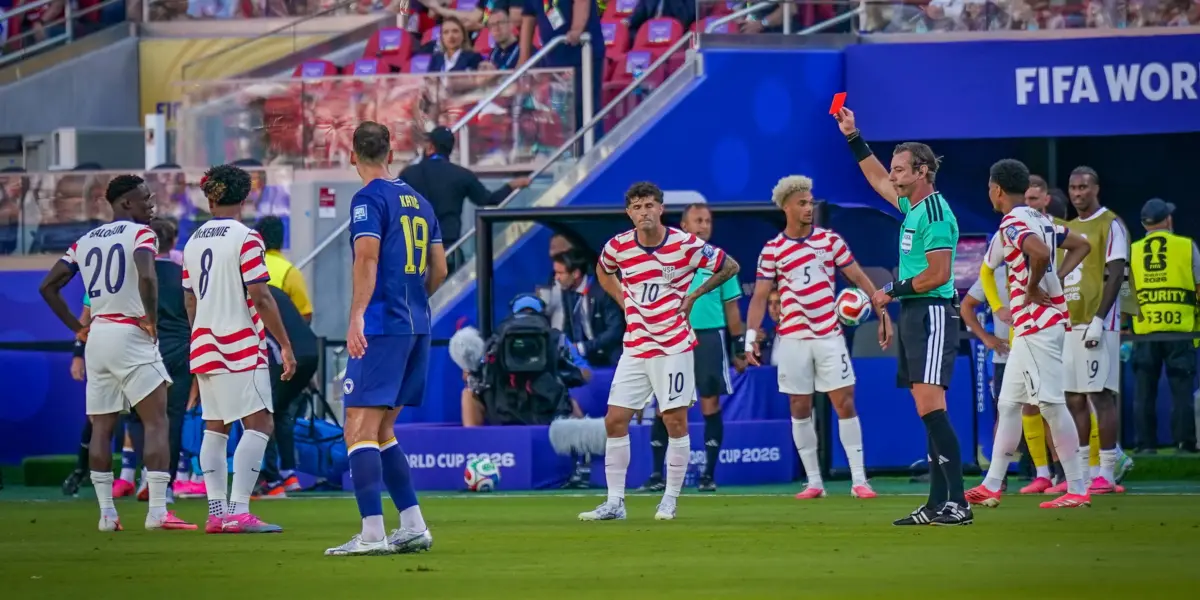
During the United States’ Round of 32 clash with Bosnia and Herzegovina, Folarin Balogun, who gave his country the lead at the stroke of half-time, was shown a straight red card in the 64th minute after replays deemed the Monaco striker’s challenge on Bosnian defender Tarik Muharemovic was excessive.
There was little dispute that contact had been made, but the real controversy centred on whether Balogun’s challenge met the threshold for serious foul play, or whether it was simply an unfortunate accident that deserved only a yellow card.
Among those who shared this view was United States manager Mauricio Pochettino, who felt the decision to hand his striker a red card was harsh.
However, under FIFA’s disciplinary rules, a player who is shown a straight red card automatically serves a one-match suspension, unless the dismissal is overturned on appeal.
With the USA set to face Belgium in the Round of 16 clash without their striker, there was a stunning twist as FIFA’s Disciplinary Committee, after invoking Article 27 of the FIFA Disciplinary Code, ruled in Balogun’s favour after reviewing the incident, suspending his automatic one-match ban for a one-year probationary period while keeping the red card on his record.
The controversy became even more explosive because of its historical significance. Controversial refereeing decisions in the World Cup are nothing new, and several players have seen red cards overturned after tournaments or have seen their disciplinary sanctions reduced.
However, what makes Folarin Balogun’s FIFA controversy a bit different is the fact that it was overturned during the knockout stages of the competition.
According to historical records, this is the first time since 1962 that a player sent off during a World Cup match has had their suspension lifted in time to feature in the very next game of the same tournament.
Folarin Balogun’s FIFA Controversy: Did Politics Cross The Line Into Football
The on-field decision to brandish the red card was a controversial one. The involvement of political figures has now transformed it into something far more serious.
The debate shifted from whether Balogun’s red card against Bosnia was deserved, to whether football’s most powerful governing body can remain independent when political pressure is applied.
According to multiple reports, senior figures within the White House, including U.S. President Donald Trump, contacted FIFA President Gianni Infantino in the hours following Balogun’s dismissal, urging FIFA to review the automatic suspension.
Ordinarily, if an appeal was to be made on the player’s behalf, it would be done through the Football Association. Allegations that the head of a host nation’s government personally became involved elevated the issue beyond a normal disciplinary issue.
To make matters worse, after FIFA suspended Balogun’s ban, the president, Donald Trump, then publicly celebrated the decision, describing it as a “reversal of a great injustice”.
Although those comments did not prove that political pressure influenced FIFA’s ruling, they have inevitably given the public a perception to run with, and in elite sports, perception matters as much as reality.
Former FIFA president Sepp Blatter also weighed in on Folarin’s overturned match suspension.
On his X account, he said: “Red cards are not overturned by political phone calls. They are overturned by rules, evidence and independent bodies.
“If a U.S. President intervenes with the FIFA President — and a player is suddenly cleared before a World Cup knockout match — the question is unavoidable: Quo vadis, FIFA?” Quo vadis means ‘Where are you going?’
For years, FIFA has insisted that they operate independently of any political influence, and that principle is the foundation of the organisation’s credibility.
If supporters begin to believe otherwise, it could affect confidence in disciplinary outcomes and the fairness of international football.
Although FIFA may continually insist that its disciplinary committee reached its verdict solely on legal and sporting grounds, if they do not come out to provide complete transparency about its reasoning, speculation is likely to persist.
YOU MAY ALSO LIKE: World Cup 2026 Goalkeepers: The Remarkable Reason They’re Producing World-Class Performances
The FIFA Statutes That Could Define This Controversy
If it is indeed true that the decision to overturn Balogun’s red card suspension was influenced by political intervention, then FIFA may have acted in a manner that appears inconsistent with several of its own core statutory principles.
FIFA Statutes, Article 4.2 – The Neutrality Principle
One of FIFA’s most fundamental promises is that football should remain separate from politics. Article 4.2 of the FIFA Statutes states that the organisation “remains neutral in matters of politics and religion.”
The principle exists to ensure that decisions affecting the sport are made solely on sporting and legal grounds, free from pressure by governments, political leaders or ideological interests.
This is exactly why the reports surrounding Folarin Balogun’s FIFA controversy have generated such intense scrutiny.
If senior political figures from the host nation actively lobbied FIFA while a disciplinary case was still under review, critics argue that the governing body has faced — and failed — a direct test of its commitment to political neutrality.
FIFA Statutes, Article 19.1 – The Independence Principle
If Article 4.2 defines FIFA’s neutrality, Article 19.1 is the mechanism designed to protect it. The statute requires every member association to manage its affairs independently and without undue influence from third parties.
Under FIFA’s governance framework, governments, presidents and political officials are considered third parties. Their involvement in football’s decision-making process is something FIFA has historically opposed with remarkable consistency.
Over the years, FIFA has repeatedly suspended or sanctioned national football associations when governments were found to have interfered in the administration of the game.
Countries such as Kuwait, Kenya and Nigeria have all faced disciplinary action after political authorities became involved in football matters, reflecting FIFA’s long-standing commitment to protecting the independence of the sport.
If investigations were to establish that political figures in the United States improperly influenced the decision to overturn Balogun’s red card suspension, many would argue that FIFA should apply the same standards it has enforced elsewhere.
Failing to do so would expose the governing body to accusations of double standards and selective enforcement, further damaging its credibility.
FIFA Statutes, Article 15(c) – Protecting Football’s Autonomy
Article 15(c) extends the principle of independence beyond FIFA itself. It requires every member association to adopt statutes that guarantee independence from political interference and protect football from outside influence.
The purpose is straightforward: football should govern football. Sporting disputes should be resolved within the organisation, either by referees, disciplinary committees and judicial bodies — not by presidents, governments or political institutions.
Folarin Balogun’s FIFA Controversy: The Global Backlash Gathering Momentum
There has been backlash from fans who have labelled both Infantino and Trump as “disgraceful”. At the same time, a host of elite managers have voiced their opinions on the issue, with former Liverpool manager Jürgen Klopp being the latest.
The new Germany national head coach said: “If that really was the case, then that’s crazy.
“Let’s just say: this is our game, not theirs. These two people, who both have no idea about football, should have nothing to do with that
“That was a red card, there’s no two ways about it. We’re sorry for Balogun because he didn’t mean to do it, but that’s what the rules say.”
Meanwhile, the USA’s Round of 16 opponent’s head coach, Rudi Garcia, also did not hide his disbelief. Speaking ahead of the knockout clash, he sarcastically remarked, “I didn’t know that at the World Cup, the fifth of July is actually the first of April – it’s April Fools’.”
Although reports claim that the Belgian FA were planning to take legal action against FIFA, seeking clarifications over the process that led to Balogun’s reinstatement.
They argued that if automatic suspension could be set aside on the eve of a knockout match without a transparent explanation, then every future disciplinary decision at the tournament could become open to dispute.