

World Cup weather concerns are becoming one of the major talking points ahead of the 2026 edition, which is set to be the biggest tournament in football history, with 48 teams competing across the United States, Canada and Mexico.
However, while fans are looking forward to the expanded competition, growing concerns over extreme weather are becoming one of the major talking points before a ball has even been kicked.
From intense heat and humidity to thunderstorms and lightning, players, coaches and climate experts have all raised concerns about how weather conditions could affect matches throughout World Cup 2026.
Climate scientists have warned that World Cup 2026 could become one of the hottest tournaments in the competition’s history.
Research suggests that around a quarter of the tournament’s 104 matches could be played in very hot conditions, with several host cities expected to experience high temperatures during June and July.
Cities such as Dallas, Houston and Miami are among the venues identified as being particularly vulnerable to extreme heat. Several Mexican host cities are also expected to experience challenging conditions during the tournament.
The issue has already been visible during pre-tournament preparations. Images of players training in sweltering temperatures have circulated widely on social media, with some teams using cooling methods such as ice collars and extra hydration measures during training sessions.
World Cup Weather Concerns Could Pose Serious Physical Challenges
Heat affects much more than player comfort. High temperatures and humidity can increase fatigue, reduce performance levels and raise the risk of heat-related illnesses.
Scientists have highlighted concerns surrounding Wet Bulb Globe Temperature (WBGT), a measure that combines temperature, humidity, sunlight and wind.
According to climate experts, 26 matches could be played in conditions where heat stress becomes a significant concern for players and supporters alike.
Some forecasts suggest that several matches could even approach conditions where postponements may need to be considered if temperatures become too dangerous.
In response, FIFA has introduced mandatory hydration breaks during matches. Teams will receive a three-minute cooling break in each half to help players manage the conditions.
National teams are already adapting. Germany recently brought in an experienced groundskeeper to help maintain training pitches in North Carolina as temperatures continue to rise during the tournament period ahead of World Cup 2026.
Storms Could Cause Major Disruptions
Heat is not the only concern facing organisers.
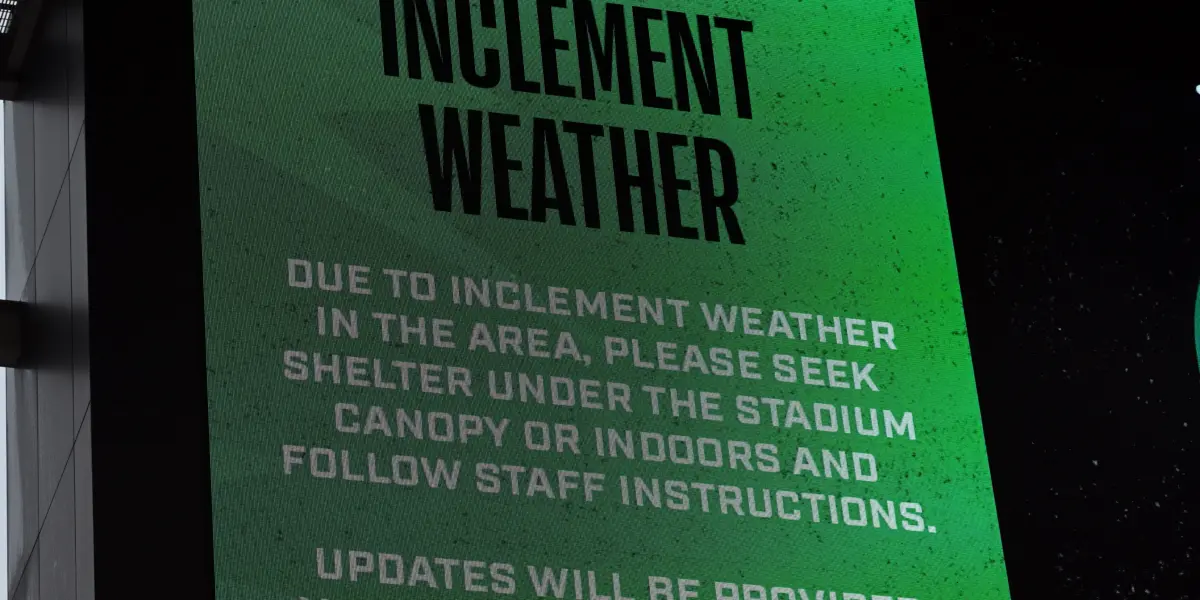
Thunderstorms and lightning are common during summer across many parts of the United States, particularly in states such as Florida. Experts have warned that severe weather could cause delays and interruptions throughout the competition.
Under American safety regulations, matches must be suspended if lightning is detected within eight miles of a stadium.
Play cannot resume until 30 minutes have passed without another strike nearby. If further lightning occurs, the countdown starts again.
As a result, delays lasting over an hour are possible.
The issue is not hypothetical. On Wednesday, June 10, England’s friendly with Costa Rica was delayed by an hour.
The week prior, the friendly between Saudi Arabia and Puerto Rico in Austin, Texas, was interrupted for nearly two hours because of thunderstorms and lightning before eventually resuming.
Former Chelsea manager Enzo Maresca also criticised lengthy weather delays during the FIFA Club World Cup in 2025 after his side experienced a significant interruption of two hours.
His comments highlighted concerns that weather stoppages could become increasingly common at major tournaments held in North America, as the Club World Cup saw multiple games disrupted ahead of World Cup 2026.
“For 85 minutes we were in control of the game,” Maresca said post-game.
“After the break, the game changed completely. For me it’s not football. It’s already seven, eight, nine games that they suspended.
“I think it’s a joke to be honest, it’s not football. It’s not for us. You cannot be inside. I struggle to understand. I can understand that for security reasons, you suspend the game. But if you suspend seven, eight games, that means that probably [this] is not the right place to do this competition.”
Fans Could Also Be Affected
While much attention has focused on players, supporters attending matches may also face challenges.
Many stadiums will host games during the hottest part of the day, exposing thousands of spectators to prolonged periods of heat and humidity.
Climate experts have warned that fans could face health risks similar to those affecting players if temperatures climb high enough.
The sheer scale of World Cup 2026 adds another layer of complexity. With 16 host cities spread across three countries and a record 104 matches scheduled, organisers will have to manage a wide range of weather conditions throughout the competition.
Some venues offer advantages. Certain stadiums feature roofs and climate-control systems that can reduce the impact of extreme temperatures. However, not every venue has the same level of protection.
YOU MAY ALSO LIKE: Host Nation World Cup Winners: The Six Times the Host Nation Has Won the World Cup

A New Challenge for Modern Football
Weather has always played a role in football, but many experts believe climate change is increasing the likelihood of extreme conditions affecting major sporting events.
The World Cup has previously dealt with challenging temperatures, including during the 1994 tournament in the United States. However, scientists warn that rising global temperatures mean the risks facing players and fans in 2026 could be even greater.
FIFA has introduced measures aimed at protecting participants, but questions remain over whether hydration breaks and stadium technology will be enough if temperatures rise beyond expected levels.
As the countdown to the 2026 tournament continues, World Cup weather concerns may prove to be one of the tournament’s defining stories, with football’s biggest challenge coming not from the opposition on the pitch but from the weather surrounding it.
World Cup 2026 kicks off on Thursday, 11 at 20:00 BST at the Mexico City Stadium, Mexico City, when Mexico host South Africa.